
If your right heel screams when you put your feet on the floor in the morning, you have probably stared at two choices online: a structured night splint with straps, or a soft sock-style splint that looks like a thick sock. I have plantar fasciitis in my right heel. It started in early 2025 after I took a part-time job at a garden center, three mornings a week on concrete. I am 64 now. My doctor sent me to physical therapy for six visits, and I still do the calf stretches. I have used the United Ortho night splint on bad weeks and a sock-style splint on nights when I wanted less fuss. The short answer is that they are not the same tool.
The United Ortho adjustable leg support brace is the one I reach for when my first steps are sharp and I know I need a real stretch. It has flexion straps, a foam liner, and padded calf and ankle straps. It adjusts from 10 to 90 degrees of dorsi-flexion. A sock-style splint is simpler. You pull it on and the fabric holds your foot in a set position. That simplicity is the point. It is also the limit. If you need to change the angle or you want a stretch you can feel, the United Ortho brace gives you more to work with.
| United Ortho night splint | Sock-style splint | |
|---|---|---|
| Adjustable stretch | Flexion straps adjust from 10 to 90 degrees of dorsi-flexion | Fixed stretch built into the fabric, no adjustment |
| Fit | Large fits men's size 9.5 to 11.5 and women's size 10 to 12.5, and it works on either foot | Comes in sock sizes, with less room to fine-tune the angle |
| Comfort in bed | Foam liner and padded calf and ankle straps help, but it is still a brace on your leg | Soft fabric against the skin and less hardware to bump |
| Putting it on | You line up several straps, which is awkward in a dark bedroom | Pulls on like a sock |
| Holding the stretch | Straps keep the foot at the angle you set | Fabric can shift as you roll over |
| Sleeping through the night | Some nights I take it off after a few hours | Easy to forget you have it on |
| Travel | Measures 15.5 by 11.5 by 5 inches and weighs 1.2 pounds | Packs flat with socks |
| Durability | Foam liner and straps are built for repeat nightly use | Elastic can relax over months |
| Best for | Stubborn morning pain that needs a firm, adjustable stretch | Mild symptoms, travel, or nights when a brace feels like too much |
The brace gives a better stretch. The sock gets worn more often. The best one is the one you will actually keep on your foot.
Where the United Ortho Night Splint Wins
Where it wins is control. Plantar fasciitis pain is often worst because the plantar fascia and Achilles tendon tighten overnight. The United Ortho brace uses flexion straps to hold the foot in dorsiflexion, which is a gentle stretch while you sleep. The part that matters to me is the range. I can start at a low angle for a few nights, then move toward a stronger stretch as my heel loosens. A sock-style splint cannot do that. It gives you one stretch, take it or leave it. On a bad week, that difference is the whole reason I keep the brace.
The second win is consistency. The brace has a foam liner and padded calf and ankle straps, so it stays where I put it. I have rolled over and found the strap still holding the angle I set. With the sock, I have woken up with the fabric twisted and my foot pointing wherever it wanted. That may sound small. But the point of a night splint is to keep a stretch going for hours, not to look tidy on the nightstand. The United Ortho brace is also built for repeat use. The foam liner and straps have held up through months of on-and-off wear. I cannot say the same for every soft splint I have tried.

Where the Sock-Style Splint Wins
Where the sock wins is comfort and convenience. It is soft, low-profile, and easy to pull on when I am already half asleep. On a night when my skin is sensitive or I have a long shift the next morning, I do not want straps around my calf. I want to pull something on and go to sleep. The sock also travels better. It packs flat in a suitcase and takes up no more room than a pair of thick socks. The United Ortho brace is 15.5 by 11.5 by 5 inches and weighs 1.2 pounds, which is fine beside the bed but not something I toss in a carry-on without thinking.
The sock also wins for mild days. If my heel is only a little stiff, a soft splint gives me a gentle reminder to keep my foot neutral without the feeling of being strapped into a device. I have had nights when the brace felt like too much and I knew I would not keep it on. The sock is better than nothing. That is not a small thing. A splint you actually wear is better than a brace you take off at 1 a.m. I still use mine for travel and for the nights after a long day when my calf is tight but my heel is not screaming.
If your morning heel pain needs more than a soft sock, start with the adjustable brace.
The United Ortho night splint lets you set the stretch from 10 to 90 degrees and keep it there. See the sizing and details on Amazon.
Amazon Check Sizing and Availability on Amazon →What Both Splints Are Trying to Do
Both splints are trying to do the same thing. They hold your foot at or near a right angle while you sleep so the plantar fascia and Achilles tendon do not shorten up overnight. That is why the first step out of bed is often the worst step of the day. If the tissue has had hours to tighten, it complains when you load it. A night splint keeps a gentle stretch on that tissue. It does not strengthen the foot. It does not fix your gait. It does not replace the stretches your physical therapist gave you. It just buys you a less angry first step. That is a modest goal, and it is the right one.
The difference is how each one gets there. The United Ortho brace uses flexion straps and a foam liner to hold the foot at an angle you choose. The sock-style splint uses fabric tension to hold the foot in a shape the maker chose. Both can work. The brace gives you more control, which is good if you need a stronger stretch and bad if you hate straps. The sock gives you less control, which is good if you want to pull something on and forget it and bad if you need more support. Neither one is a cure. They are both just ways to keep your foot from curling up while you are unconscious.
How I Tested Both
I tested both kinds over several months in 2025, not in a lab. I wore the United Ortho brace on my right foot for two or three nights in a row when my morning pain was sharp, then took a break when my skin needed one. I wore the sock-style splint on easier nights, on trips, and on the nights when I came home from the garden center too tired to line up straps. I kept a notebook by the bed for the first month because I wanted to know what actually changed. What changed was not a straight line. Some mornings were better. Some were the same. The pattern was that the brace gave a stronger stretch and the sock got worn more often.
I am not a podiatrist, and I am not going to pretend a night splint is a cure. My doctor diagnosed plantar fasciitis in spring 2025 and sent me to physical therapy. The six visits taught me calf stretches and a towel stretch I still do before bed. The night splint was one part of the routine, along with supportive sneakers at work and insoles in those sneakers. If you are looking for a single product that fixes everything, neither of these will do it. If you are looking for a way to hold a gentle stretch overnight, the question is which one you will actually keep on your foot.
The Comfort Trade I Had to Accept
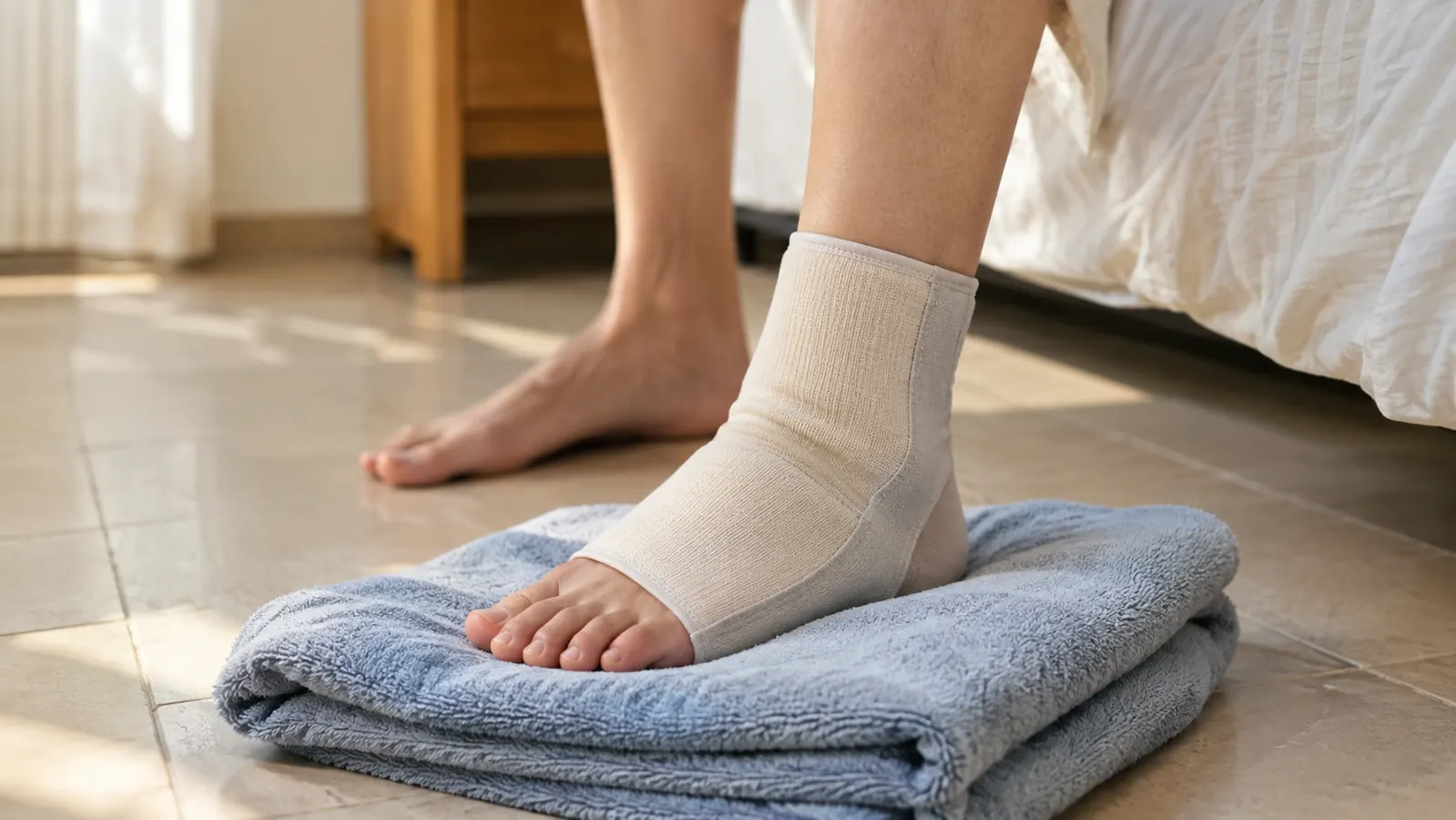
The comfort trade is the part I did not understand until I had worn both for a few weeks. The United Ortho brace is not painful, but it is present. You feel the straps. You feel the foam liner. You feel the angle. If you are a light sleeper, that can be the difference between wearing it for six hours and wearing it for two. The sock is less present. It is still something on your foot, but it does not have the same bulk or the same straps. On a night when I was already tired and a little cranky, the sock won because I knew I would keep it on.
That is not an argument for the sock in every case. It is an argument for being honest about what you will tolerate. A stronger stretch that sits in the closet does nothing. A milder stretch that you wear every night can help. I landed in the middle. I use the brace on bad weeks and the sock on easy weeks. If you have a low tolerance for things on your feet at night, start with the sock and see if it is enough. If it is not, move up to the brace. If you cannot sleep in either one, tell your doctor or physical therapist. There are other ways to manage morning pain.
What I Wish I Had Known About Sizing
I wish I had known that sizing is not a small detail. The United Ortho large fits men's size 9.5 to 11.5 and women's size 10 to 12.5. If you are near the edge of that range, measure your foot instead of guessing from your shoe size. Shoe sizes vary by brand. A brace does not. I also learned that the brace works on either foot, which sounds obvious until you are fumbling in the dark and grab it with the straps facing the wrong way. It took me a few nights to get the hang of it. That is not a defect. It is just a new routine.
A sock-style splint has its own fit issues. It has to be snug enough to hold your foot without cutting off circulation. If it leaves deep marks in the morning, it is too tight. If it slides off in the night, it is too loose. I had one that felt fine when I put it on and was halfway off by 3 a.m. That is the kind of thing you only learn by wearing it. Neither splint will work if the fit is wrong. That is why I would rather buy from a place with clear sizing and a return policy than save a few minutes and guess.
The Morning Routine That Made Either Splint Work Better
The other thing that helped was a morning routine. Before I take a step, I sit on the edge of the bed and do the towel stretch my physical therapist taught me. I pull my toes toward me for about 30 seconds, three times, and then I put my feet into the slides I keep by the bed. Only then do I stand up. The night splint helps keep the tissue from tightening. The morning stretch helps wake it up. The slides keep my tile floor from undoing the work. None of that is complicated. It is just easier to do when I have the splint on the night before.
I also learned not to judge a splint by the first night. The first night in the United Ortho brace was awkward. I could not get comfortable. The second night was better. By the fourth night, I had a routine. The sock was easier from the start, but it also did less. If you try a night splint and hate it after one night, give it a few more nights before you decide. Unless it is painful or your foot goes numb, in which case stop and call your doctor. That is not a failure. That is information.
Who Should Buy Which
Buy the United Ortho night splint if your morning pain is the main event and you can tolerate a brace for part of the night. It makes the most sense if you have tried a soft sock splint and felt it was too loose, or if your physical therapist told you to hold a dorsiflexion stretch. It also makes sense if you want one brace that works on either foot and lets you change the angle as your heel calms down. The size large fits men's 9.5 to 11.5 and women's 10 to 12.5. Measure your foot before you order, because a poor fit is the fastest way to hate a night splint.
Buy a sock-style splint if you need something simple, soft, and easy to travel with, or if your symptoms are mild and a full brace feels like overkill. It is also the better first try for anyone who knows they will not sleep in straps. Neither one is a cure. I still do my calf stretches, I still wear supportive sneakers at work, and I still see my doctor when something changes. If your pain is severe, sudden, or getting worse, call your doctor or podiatrist. A night splint is a tool, not a diagnosis.
The brace I keep by the bed on bad weeks.
Adjustable from 10 to 90 degrees, padded calf and ankle straps, and a foam liner. See the sizing and details on Amazon.
Amazon See the United Ortho Night Splint on Amazon →