

The first thing I do every morning is not check my phone or start the coffee. It is sit on the edge of the bed, put both feet flat on the tile, and wait. For most of 2025 that wait was the worst part of my day. My right heel would light up with a sharp, hot pull the second I put weight on it, and I would shuffle to the bathroom like a woman of ninety instead of sixty-four. I started at the garden center in early 2025, three mornings a week on a concrete floor, and my right heel has been arguing with me ever since.
I tried what most people try first. Supportive walking sneakers instead of my old flats. A frozen bottle of water rolled under my arch while I watched the evening news. The calf and towel stretches my physical therapist gave me after my doctor diagnosed plantar fasciitis in the spring of 2025, which I still do most mornings. All of it helped around the edges. None of it did a thing about the concrete. What changed my days was the PowerStep Pinnacle, a molded orthotic I put in after pulling the flat factory insert out of my sneakers to make room, and after months in a pair I can tell you plainly what they fixed, what they did not, and who I would tell to save their money.
The Quick Verdict
The first insole that made a concrete floor feel like a floor again. Not a cure, and not friendly to every shoe, but months in I still reach for them first.
Amazon Check Today's Price →The pair that lives in my work sneakers
I keep one pair in the walking shoes I wear to the garden center and move them into my evening walkers when I clean them. If your first steps out of bed are the worst part of your day, start here.
Amazon Check Today's Price on Amazon →How I've Used It
The pair I bought is the men's 11 to 11.5 and women's 13 to 13.5 size, which is what lined up with the factory insole in my work sneakers when I set the two side by side on the kitchen counter and squinted at them. I have long feet and I have never once been described as dainty. Ray says I could waterski without the skis. The size chart on the listing is the one to trust here, because these are molded inserts and not something you want to guess at from memory or from the size of your slippers.
My routine has not changed much since they arrived in the mail. Three mornings a week I am on my feet at the register from eight until just past noon, mostly standing, sometimes walking a cart of flats out to the loading area, sometimes crouching to pick up a bag of potting soil that somebody set down in the wrong aisle. Most evenings, when the heat backs off, Ray and I walk about two miles along the bayfront path. The PowerStep pair lives in the work sneakers. On walking evenings I move them over, which takes about ten seconds and is the only maintenance they ask of me.
Before these I spent a few months in a cheap drugstore insert, the kind that costs less than a decent lunch and feels like a piece of cardboard with an opinion. It flattened out inside a week. I could fold it in half with two fingers by August. The difference between that thing and the PowerStep is not subtle. One of them is a cushion. The other one is support, and support is the piece that was missing from my whole setup.
I want to be clear about what I am not. I am not a runner. I am not a hundred and ten pounds. I am sixty-four, I carry a little extra around the middle, and my foot problem is the everyday kind that shows up in an ordinary life rather than a training log. If you are looking for a review from someone doing marathons and tracking their split times, this is not it. If you are looking for someone who has to stand at a register on a slab of concrete for four hours and then walk a bayfront path at dusk with her retired husband, this is exactly it.
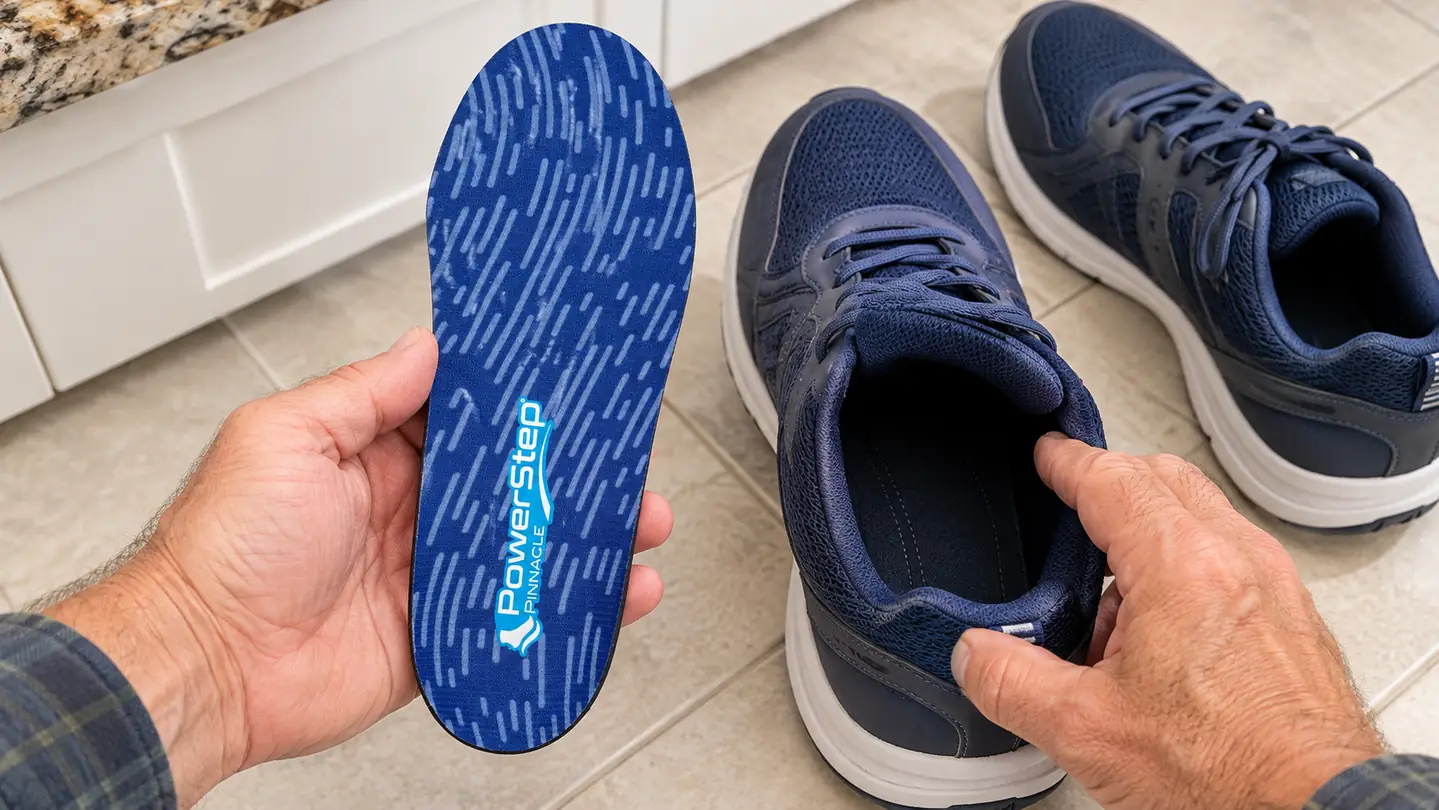
What a Semi-Rigid Shell Actually Feels Like Underfoot
The listing calls it a semi-rigid polypropylene support shell, and the top layer is ethylene vinyl acetate, which everyone in the shoe business just calls EVA. What that means inside a shoe is this: the arch does not squish away from you. When I put weight down, something is there. With the factory insert my arch simply flattened into the shoe and my heel took the whole landing, step after step, hour after hour, all morning long. With the PowerStep Pinnacle, the middle of my foot is held up by a shell that gives a little but does not collapse, and the EVA on top keeps it from feeling like standing on a piece of cut plastic.
The first hour was strange. Not painful, just strange, the way a new pair of glasses is strange for the first afternoon. I could feel exactly where my arch was, which is a sentence I had never had occasion to say before in my life. By the end of that first shift the strangeness was gone and I had stopped thinking about my feet, which is the whole point of any of this. I do not notice the insoles now. I notice when I forget them, and forgetting them is the only way I have found to remind myself what a difference they make.
One more thing about the shell. The listing calls it moderate pronation support, and it does not try to force your foot into a position. It holds. There is a difference between an insole that pushes your arch up and one that simply refuses to let it drop, and this is the second kind. I have no idea how they engineer that in a factory. I only know my right foot stopped rolling inward the way it had been doing all day on that concrete.
The pair weighs 6.4 ounces, and the listing gives the dimensions as 14.2 by 1.8 by 4.4 inches. That is not a lot of weight to add to a shoe, and I have never felt like I was lugging something around. The tradeoff is volume, not weight, and I will get to that further down.
The First Two Weeks, and What Changed by Month Four
I want to be honest about the timeline, because the internet is full of people claiming a turnaround in forty-eight hours and I do not believe them. Week one, my heel hurt exactly as much as before. What changed in week one was not the pain, it was the end of the day. I noticed at four in the afternoon that I was not limping out to my car. Before the insoles I would get to the car and sit there for a minute with my right foot up on the floor mat, waiting for the ache to settle before I trusted myself to drive home.
By week three, the mornings started to change. The first steps out of bed were still the worst part of the day, but the sharp hot pull had softened into something closer to a dull ache that worked itself out in a couple of minutes instead of ten. That is the change I care about most, because those first steps tell you whether the rest of the day is going to be a fight or just a day. My left foot, which has only ever had a mild ache on long days, felt no difference at all, which told me the change was coming from the support and not from me simply having a good week.
By month four, this is where I landed. Most mornings are a dull ache that loosens quickly. I have good weeks and bad weeks, and the bad weeks usually follow a Saturday when I did too much in the yard or stood around in the wrong shoes at a family thing. The PowerStep Pinnacle did not cure my plantar fasciitis. What it did was take the concrete out of the equation, and the concrete was the thing I could not avoid, short of quitting a job I actually like. My physical therapist was the one who fixed my tight calves. The insoles are the reason I could keep working while I did the rest of it.
Cushioning, Wear, and the Concrete Test
The listing advertises superior heel cushioning, and my version of testing that is unscientific but real: four hours at a register on a concrete slab, then a walk to the car, then the drive home, then the walk from the driveway across tile to the kitchen, then the walk back out to the mailbox because I forgot the mail. The heel cushioning is not soft the way a gel insert is soft. It is closer to firm and quiet. Nothing bounces. Nothing squishes. My heel just stops being the thing that hits first.
Wear has been better than I expected. After months of daily use, the EVA top layer has the imprint of my foot in it, which is normal and not a problem, and the edges have not curled or separated. I pull them out every couple of weeks and rinse them in the sink, and I let them sit on a dish towel overnight before they go back in. They have held their shape. The shell underneath is as stiff as the day they arrived, which is either good news or bad news depending on what you want from an insole. I wanted stiff. Stiff is the whole reason I bought them.
One thing I did not expect: they made my evening walks better in a way I noticed before I noticed the register shifts. Two miles on a paved path is not a lot, but before the insoles I would feel my right heel for the last half mile every single time, and I would cut the walk short and blame the heat. Now I mostly do not think about it until I am taking my shoes off at the door. Ray noticed too, because I stopped being the one who wanted to turn around early.
Where the PowerStep Pinnacle Falls Short
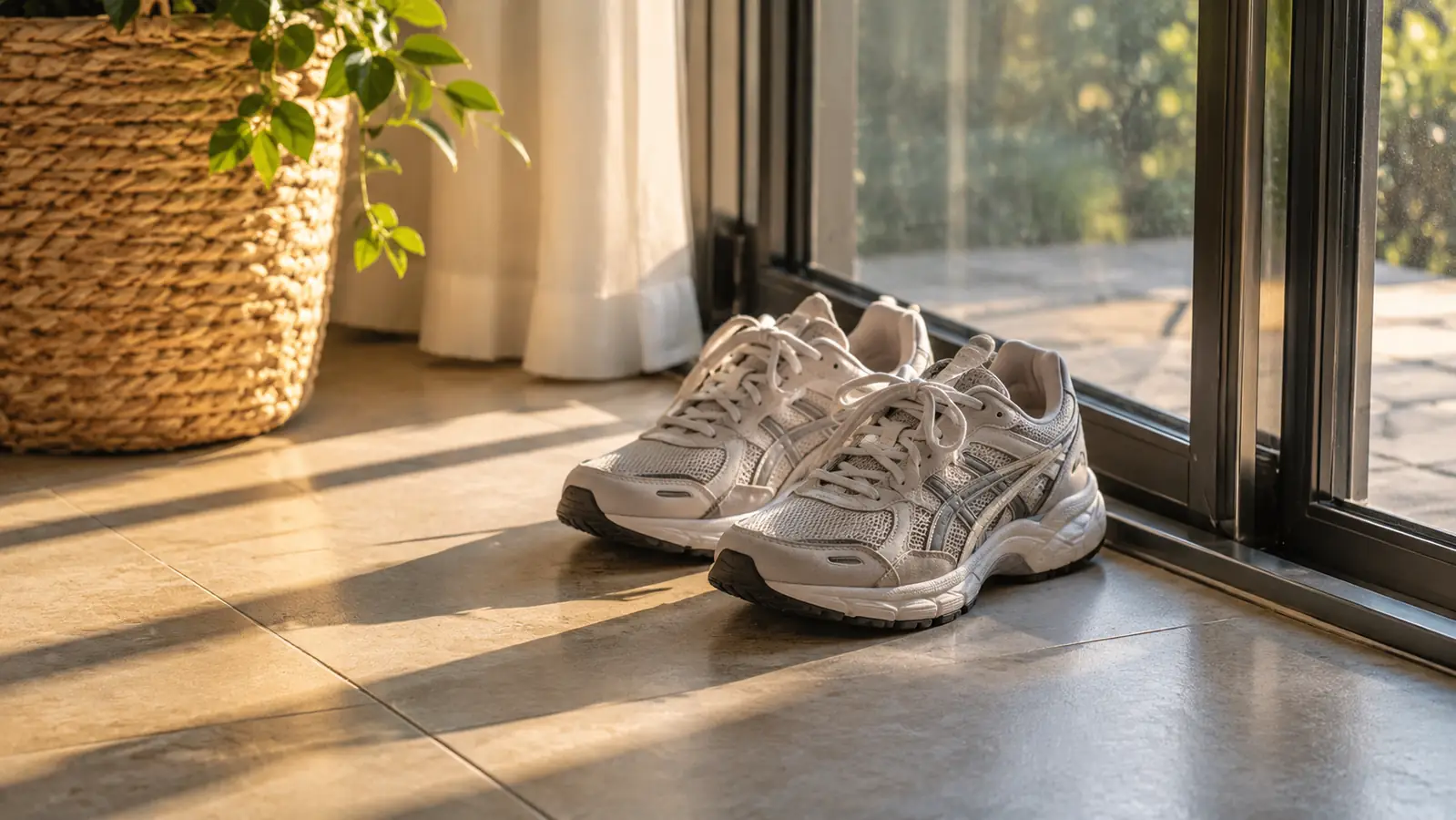
Volume. That is the main one. These are not thin inserts, and they take up room inside a shoe. In my walking sneakers there is plenty of space, so it was never an issue. But I tried them in a pair of slip-on shoes I wear to church and my toes were pressed against the top of the shoe before I even stood up. If your everyday shoes are snug, these will make them unwearable, and there is no trick around that. The listing does say they can go in athletic and walking shoes, and in my experience that is exactly right.
Second, they are not soft. If you want the feeling of stepping onto a pillow, this is the wrong product for you and I would rather say so now than have you find out in a week. Some people want that pillow feeling and I understand it. My neighbor swears by her gel inserts and I am not going to argue with her, because her feet are not my feet and her job is not my job. I wanted support under the arch, not cushion under the whole foot, and that is what these deliver. If you want plush, look elsewhere.
Third, they did not fix the underlying problem, and nothing you put in a shoe is going to. My calves were tight, my plantar fascia was angry, and the insoles bought me the ability to keep working while the stretching and the physical therapy did the real work. I still do the towel stretch every morning before I stand up. I still use the night splint on bad weeks. Anybody selling you an insole as a standalone cure is selling you something other than an honest description of what an insole does.
What I Liked
- The arch support is genuine. A semi-rigid polypropylene shell that does not collapse under weight.
- Heel cushioning that holds up through a four-hour shift on concrete.
- Held their shape after months of daily use, with no curling or separation at the edges.
- They fit in ordinary walking and athletic shoes without changing how the shoe laces.
- Made in the USA, with a 30-day money-back guarantee if they do not work for you.
Where It Falls Short
- Thick enough that snug or narrow shoes become unwearable.
- Firm under the whole foot rather than plush, which some people will not like.
- Does nothing on its own about tight calves or the cause of the pain.
- They only do their job if you commit to wearing them in every pair you stand in.
By week three the first steps out of bed had gone from a sharp, hot pull to a dull ache that worked itself out in a couple of minutes. That is the change I care about most.
Who This Is For
If you stand on a hard floor for a living, this is the closest thing to a fix I have found that you can buy without a prescription. Cashiers, nurses, teachers, warehouse, salon, restaurant line. If your first steps out of bed are the worst part of the day and the rest of the day is a long slow argument with a concrete slab, the PowerStep Pinnacle is worth trying before you spend more money on another pair of shoes that promises to be the answer on its own.
It is also for the people who tried the drugstore inserts, found them flimsy, and want to know whether the next step up is worth it. Ray does not have my heel problem, but he tried a pair in his own shoes for a week and asked me to order him some, which from Ray is a rave. He is on his feet in the garage most of the day and he does not complain about his back the way he used to. I would not call that proof of anything. I would call it a good sign from a man who does not hand out compliments to footwear.
Who Should Skip It
Skip them if your shoes are narrow or snug. Skip them if you want something soft and cushioned under the whole foot rather than a firm arch. Skip them if you have a dress shoe problem, because these are not going into a dress shoe and pretending otherwise will only frustrate you. And skip them if you are not willing to move them from pair to pair, because an insole that stays in the closet does nothing at all for a heel.
And skip them, please, if the pain is severe, sudden, or getting worse instead of better. My heel pain came on gradually, my doctor diagnosed it, and she sent me to physical therapy for six visits, and that order of events matters more than any product. A sudden sharp pain, numbness, swelling, or pain that does not improve after a few weeks of sensible effort is a reason to see a podiatrist, not a reason to buy another insole off the internet. I am a retired schoolteacher who stands at a register three mornings a week. I am not your doctor, and I would not want to be.
If your first steps out of bed are the worst part of your day
These are the pair I keep in my work sneakers, and they are the reason I could stay on the concrete while my heel settled down. The listing has the size chart and the 30-day guarantee. Start there.
Amazon Check Today's Price on Amazon →