
The first thing I do every morning is not check my phone. It is put both feet on the tile beside my bed and decide, in about half a second, what kind of day the right heel is going to give me. For most of 2025 the answer was a bad one. I am sixty-four, retired after thirty-one years of teaching third grade, and I work three mornings a week as a cashier at a garden center on the Gulf Coast of Florida. The floors there are concrete and the register has no stool.
By February the heel was stabbing me before I was properly awake. My doctor gave it the name plantar fasciitis and sent me to a physical therapist for six visits. The therapist explained the part that mattered most: the fascia tightens overnight while you sleep with your foot pointed, which is why the first steps out of bed are the worst steps of your day. That is how I ended up reading about the United Ortho plantar fasciitis leg support brace at eleven o'clock one night with a heating pad under my calf.
The Quick Verdict
Uncomfortable enough that I take it off some mornings with real relief, and useful enough that I put it straight back on the moment the first steps go sharp. It bought back my mornings. It did not cure anything.
Amazon Check Today's Price →The thing I strap on at night when my first steps go sharp
The United Ortho leg support brace holds your foot at a stretch overnight so the morning walk to the bathroom stops being the worst fifteen feet of your day. It fits the right or left foot, and the angle adjusts.
Amazon Check Today's Price on Amazon →How I've Used It
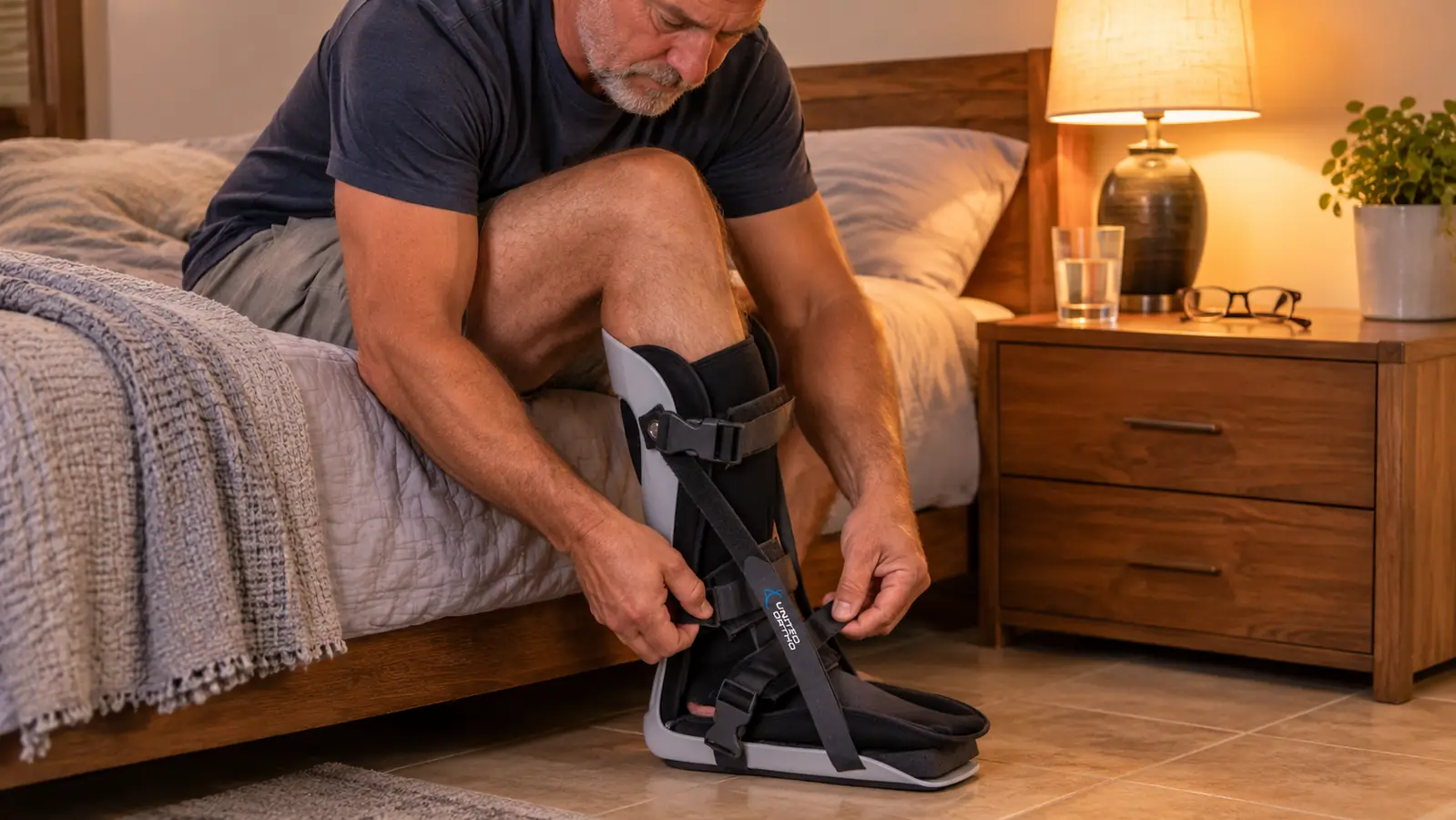
I wear it on the right foot and only the right foot. My left heel has the occasional ache after a long day, nothing more, and I have never had a reason to test the brace there, though the United Ortho brace is built to fit either side. The routine is simple enough. Before bed I sit on the edge of the mattress, set my heel in, and close the padded strap around my ankle and the wider one around my calf. Then I set the flexion straps, and those are the whole business. They decide the angle your foot is held at overnight.
I started near the gentle end of the adjustment range, which was the right call and the only call my foot would have tolerated. For the first week I wore it maybe two hours a night, then took it off in the dark without turning on a lamp so I would not fully wake up. By the third week I was wearing it through the night. Six months in, I use it four or five nights a week. More during a bad stretch, less during a good one.
The brace is a big object, 15.5 by 11.5 by 5 inches by the box, a little over a pound, so it is not the sort of thing you forget you have on. The foam liner stays cooler than I expected, and the padded straps at the ankle and calf keep the edges from digging in. In a Florida summer it still gets warm by two in the morning. I have not found a way around that except a fan pointed at the foot of the bed, which Ray finds funny and has stopped commenting on.
What the Brace Is Actually Doing to Your Foot
Here is the plain version, the way my therapist explained it. The plantar fascia is a band of tissue that runs along the bottom of your foot from the heel to the ball. Overnight, with your toes pointed and nothing pulling against it, that band shortens and settles. Then you stand up in the morning and stretch it all at once, and it complains. Loudly. A night splint does not treat the fascia. It keeps the fascia from shortening in the first place by holding your foot at an angle while you sleep.
That angle is the entire product. The United Ortho brace adjusts from 10 to 90 degrees of dorsi-flexion, which in plain terms means how far your toes are pulled back toward your shin. Ten degrees is a gentle hold. Ninety is a serious stretch. There is a real temptation, the first night you own one of these, to crank it to the far end and get it over with. I did that on night four and paid for it with a calf that ached through the next day.
The other half of the job is the Achilles tendon, which sits on the same line of pull. The flexion straps stretch both, which is why the brace feels like it is working on the back of your leg as much as the bottom of your foot. That surprised me. I bought it for the heel and ended up with a calf stretch I could never get standing at the kitchen counter.
The First Two Weeks Are the Worst of It
Nobody warned me properly about this part, so I will warn you. Sleeping with your foot held at an angle is not natural and your body knows it. For the first ten nights I woke around two or three with a cramped, restless feeling in the calf and a strong desire to kick the thing off. Twice I did. I am not proud of it.
The padding helps. The foam liner helps. None of it makes the first week comfortable. What got me through was cutting back. Two hours a night, then three, then four. I also stopped trying to sleep a whole night in it after a long shift on my feet. On those nights I wore it for an hour before bed, took it off, and slept normally. Half a night of stretch beat no stretch at all.
By the end of the second week the waking up stopped. My foot had not changed much yet, but my body had quit treating the brace as an intruder. That is the honest timeline. If you buy one of these expecting to sleep straight through from night one, you will be disappointed, and you will leave a one-star review that scares off someone the thing would have helped.
What Changed Over Six Months
The change was gradual and it was not a straight line. Around week four I noticed the walk from the bed to the bathroom had stopped being dramatic. It was a dull ache instead of a stab. By week eight, on a good morning, I could get up and put weight on it without bracing myself against the door frame first.
Six months in, that is roughly where I sit. Most mornings are a dull ache that loosens in a few minutes. I still have bad weeks. If I spend a Saturday on my feet in the yard, or skip the stretches four days running, the sharp version comes back and the brace goes on every night until it settles down. The night splint did not fix my foot. What it did was break the cycle where the fascia tightened overnight and I re-injured it every morning before breakfast.
I want to be clear about what it does not do. It does nothing for the middle of the day. Once I am up and moving, the brace is in a drawer. It does nothing for the ache that shows up after an hour at the register. And it does not replace the stretches or the insoles. When I got lazy about all three at once, the heel let me know inside a week.
The Fit Question Matters More Than Anything
This is the part I would underline if I handed you the box. The sizing is not generous and it is not vague. The Large is listed for men's 9.5 to 11.5 and women's 10 to 12.5, and the listing says plainly to measure your foot rather than guess. I measured mine with a tape and a sheet of paper against the wall, and I landed in the Large. If you are between sizes, that is a question for the seller, not for a review.
The straps adjust, which buys you some room, but the brace itself is sized. One that is too big will slide and the stretch will not hold. One that is too small will pinch across the top of your foot and you will not keep it on past the first hour. That is the main reason these end up in a closet. Not because they do not work, but because they do not fit, and the person wearing it decides the whole idea is bad.
One more practical note. The United Ortho brace fits either foot, but you wear it on one leg at a time, and if both heels are bad you are going to need a longer conversation with your podiatrist. My left foot has never needed it, and I hope it stays that way.

Two Things I Would Change
If I could change two things about this brace, I would start with the weight. A little over a pound does not sound like much until you have it on your leg at three in the morning and you roll over. Something lighter would be easier to live with. I do not know how you make it lighter without losing the stretch, which is probably why it is built the way it is.
The other is the warmth. The foam liner is described as cool, and it is cooler than the look of the thing suggests, but Florida in August is Florida in August. On the worst nights I have slept with one foot out from under the sheet and a fan running. It is a small complaint. It is also the reason I take it off on some mornings before I strictly need to.
Where It Fits With Everything Else I Do
A night brace is one piece of a routine, not the routine. The rest of mine, in the order I use it: PowerStep Pinnacle insoles in my work sneakers, which are the only shoes I wear for a shift. The BESKAR foot roller that lives by the couch, which I roll over for five minutes while the news is on. OOFOS OOahh slides for the tile floors at home, because I stopped going barefoot in this house a year ago and I am not going back. And on long shift days, a BLITZU compression sleeve.
The brace sits on top of all that. It does the one job none of the others can do, which is the eight hours when you are asleep and cannot stretch anything. The insoles cushion the walk. The roller loosens what is tight. The slides keep the tile from beating up my heel at home. The splint keeps the overnight tightening from undoing all of it before I get my coffee.
If you can only do one thing, pick the one that matches your worst hour. Mine was the first hour of the day, so the night brace earned its spot on the shelf. If your worst hour is two in the afternoon at work, start with insoles and shoes instead and come back to this later.
What I Liked
- Keeps the plantar fascia and Achilles from tightening overnight, which is the actual cause of first-steps pain
- Adjusts from 10 to 90 degrees, so you can start gentle and work up over a couple of weeks
- Padded calf and ankle straps and a foam liner keep the edges from digging in
- Fits the right or left foot, so one brace covers whichever heel is giving you trouble
- Sizing is spelled out in plain numbers for men and women, and the Large covers a real range of feet
Where It Falls Short
- The first week or two of sleep is genuinely rough, and no amount of padding fixes that
- It weighs a little over a pound and takes up real space in bed, and it gets warm on a summer night
- It does nothing for pain in the middle of the day, which is a hard thing to explain to yourself at 2 p.m.
- Sizing is unforgiving if you do not measure first, and a wrong size slides or pinches
- The angle takes a few nights to dial in, and there is no single setting that suits every person
The night splint did not fix my foot. What it did was break the cycle where the fascia tightened overnight and I re-injured it every morning before breakfast.
Who This Is For
This is for the person whose worst pain is the first ten steps out of bed, who has already tried the insoles and the stretches and the roller and is still hobbling to the bathroom at dawn. It is for someone who stands on hard floors for a living and can feel the whole day being set by how the morning goes. It suits people willing to lose a week of decent sleep to get there, because that is the price of admission. And it suits anyone whose doctor or therapist has already used the words night splint and who wants to know what the thing is actually like before buying one.
Who Should Skip It
Skip it if your pain is not worst in the morning. A night splint works on one specific mechanism, and if your heel hurts most after a long day and feels fine at six in the morning, this is the wrong tool. Skip it if you know in your bones you will not tolerate a week of broken sleep, because you will take it off on night two and never put it back on. Skip it if you have not seen anyone about the pain yet, especially if it arrived suddenly or is severe, or if there is numbness or tingling in the foot. That is a doctor conversation, not an online order. And skip it if you are not going to measure your foot first.
If your worst ten steps are the ones to the bathroom, start here
The United Ortho leg support brace holds the stretch while you sleep, adjusts from a gentle hold to a firm one, and fits either foot. Measure before you order, give it two honest weeks, and keep up the stretches.
Amazon Check Today's Price on Amazon →