
Two insoles, two very different ideas about what a sore heel actually needs. The PowerStep Pinnacle is a molded orthotic built around a semi-rigid polypropylene support shell, made in the USA, and sold in shoe sizes. Dr. Scholl's makes a whole family of cushioning insoles that you can pick up at the drugstore on the way home from work. I have worn both in the same pair of walking sneakers, on the same right heel, through the same Gulf Coast summer. The difference between them is real, and it is not the difference the packaging suggests.
Here is the short answer before the long one. If you have plantar fasciitis and a genuine arch support problem, the PowerStep Pinnacle does more work. It holds the arch up under your weight instead of only padding the bottom of your foot, and it keeps holding it up after a month of long shifts on concrete. Dr. Scholl's is the smarter first step if you are not yet sure insoles will help at all, if your shoes run tight, or if your heel is currently too sore to tolerate anything firm underneath it. I keep a pair of each in the hall closet, and I would not part with either one.
| PowerStep Pinnacle | Dr. Scholl's insoles | |
|---|---|---|
| Arch support | Semi-rigid polypropylene shell holds the arch up under load | Foam arch cushion that supports the shape of the arch |
| Cushioning | Firm under the heel with an EVA top layer, not plush | Softer underfoot from the minute you put it in |
| Break-in | A few short days before a full shift feels normal | Comfortable on day one |
| Sizing | Ordered by shoe size, the listing size being Men's 11-11.5 / Women's 13-13.5 | Trim-to-fit lines, one length covers a range of feet |
| Room inside the shoe | Takes up real volume, best in athletic and walking shoes | Thin profile slips into more of the shoes already in the closet |
| Durability | Shell holds its shape through months of daily shifts | Cushioning compresses and flattens with daily use |
| Where you get it | Ordered online in the size you need | Drugstore shelf, no waiting |
| If it does not work out | 30-day money-back guarantee from PowerStep | Store return policy plus the brand's own satisfaction guarantee |
| Best for | Daily standing and walking with a diagnosed arch problem | Finding out whether insoles help at all, or a heel too sore for firm support |
How I Ended Up Wearing Both
My right heel started hurting in early 2025, a few weeks after I took a part-time job as a cashier at a garden center. Thirty-one years of teaching had been hard on my feet in a general, background way, but this was different. The worst part was the first steps out of bed, a sharp pull right at the bottom of the heel that made me sit back down on the edge of the mattress and wait. My primary care doctor diagnosed plantar fasciitis that spring and sent me to a physical therapist for six visits. The therapist taught me the calf stretches and the towel stretch I still do most mornings.
What she could not do was change the floor I stand on. The garden center is concrete under a thin rubber mat, and I am on it three mornings a week. So I started with the easy thing. I bought a pair of Dr. Scholl's insoles at the drugstore, trimmed them along the lines to fit my walking sneakers, and put them in that night. For about two weeks I thought I had it licked. The heel felt cushioned, the mornings were easier, and I told Ray I should have done it months earlier.
Then the cushioning started to give. Not a dramatic failure, just a slow flattening. By the end of the first month I was right back where I started, and the insole had a permanent dent where my heel sat. That was the point where I stopped thinking about insoles as padding and started reading about arch support, which is how I found the PowerStep Pinnacle. PowerStep sizes theirs by shoe size rather than one cut-to-length panel, and the size on this listing is Men's 11-11.5 / Women's 13-13.5. That matters more than it sounds like it does, and I will come back to it.
What the Semi-Rigid Shell Actually Does
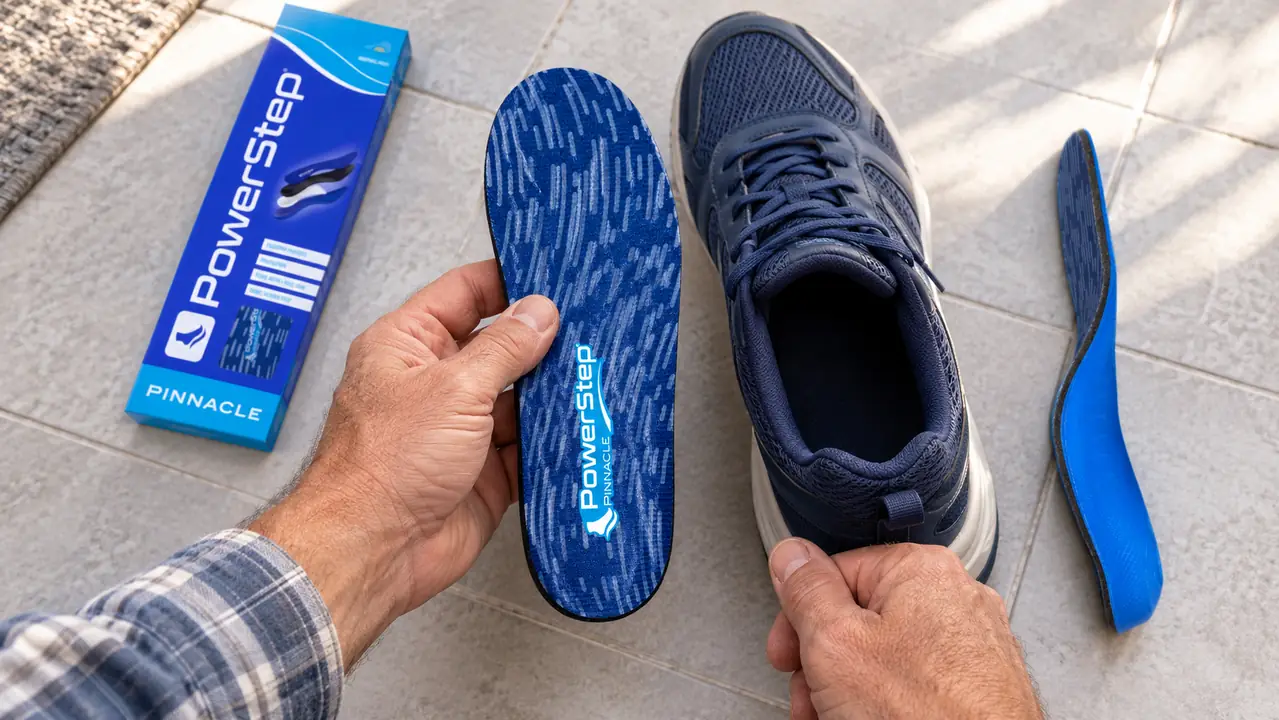
An insole can do two jobs, and they are not the same job. It can cushion the bottom of your foot, which is what the drugstore insoles do well. Or it can support the arch from underneath, so the plantar fascia, that band running from your heel to the ball of your foot, is not being stretched every single time you stand up. The PowerStep Pinnacle is built for the second job. Under the EVA top layer there is a semi-rigid polypropylene support shell, and that shell is the part doing the actual work. PowerStep also lists moderate pronation control on the label, which is a technical way of saying it rolls the foot back toward center.
The first week felt strange. Firm is the word. Not painful, but very clearly not a cushion. I wore them for two hours at a time for the first few days, then a full shift, which is roughly the break-in a molded insole seems to need. By the second week I had stopped noticing them during the shift at all. What I noticed instead was the morning. The first steps out of bed went from a sharp pull to a dull ache that loosened up in a couple of minutes, and that has held through good weeks and bad ones ever since.
There is a catch worth knowing before you order. These take up real volume inside a shoe. The package measures 14.2 by 1.8 by 4.4 inches and lists 6.4 ounces, and you pull the factory insole out first to make room. They fit my walking sneakers fine. They do not fit the flat little slip-ons I wear to church, and I never expected them to. PowerStep lists athletic and walking shoes among the shoe types these are made for, which matches exactly what I found in my own closet.
What I Got Wrong the First Time
Two mistakes, both cheap to fix and both worth passing along. The first was wearing the new firm insoles for a ten-hour day immediately. My heel was angry with me for two days afterward, and I very nearly decided the whole thing was a waste of money and went back to the soft pair. If you are coming off a cushioning insole, give a supportive one a few short days before you hand it a full shift. Two hours on, two hours out, then build up. It sounds fussy. It is the difference between a fair test and a false one.
The second mistake was assuming the insoles would fix everything by themselves. They did not. What actually moved the needle was the boring combination: the PowerStep in the work sneakers, the calf and towel stretches from the physical therapist twice a day, and no more walking around my own tile floors in bare feet. I bought a pair of recovery slides to wear inside the house, and that alone cut the morning pain more than I expected it to. Insoles are one leg of the stool. They are not the stool, and anyone who tells you otherwise is selling something.
Where PowerStep Pinnacle Wins
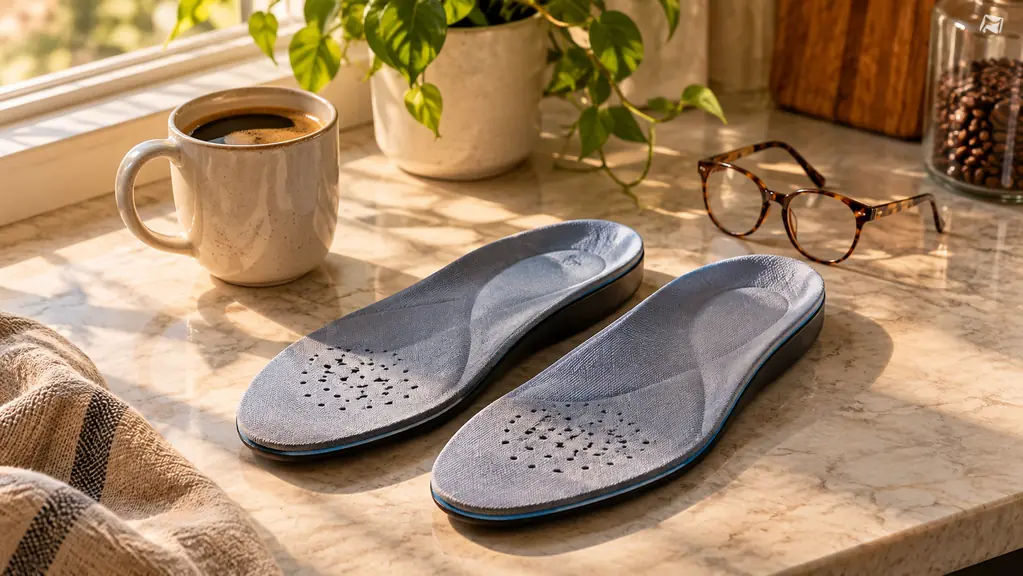
It wins on the thing the whole purchase is about: holding the arch up while you are standing on it. On a concrete floor, eight hours in, the Pinnacle still felt like it was doing a job. The Dr. Scholl's insole felt like a nice thought I had had a month ago. That is not a knock on Dr. Scholl's so much as a description of what foam can do over time. Foam cushions. A shell supports. If your problem is the morning pull of a tight plantar fascia, support is the part you cannot skip. PowerStep calls the Pinnacle the number one podiatrist recommended insole, which is a marketing claim I cannot check, but it is how I found the thing in the first place.
It also wins on staying the same in month three as it was in week two. Mine has not flattened, dented, or gone soft at the heel. I rotate them between my work sneakers and my evening walking shoes and they have held up. PowerStep backs them with a 30-day money-back guarantee, which is a fair window if you use it the way I described, a few hours a day at first. Thirty days is enough time to know whether a firm insole is going to work for your foot. It is not enough time to wear one out, so you are not going to be stuck with something that failed on you.
Where Dr. Scholl's Wins
It wins on comfort right out of the package, and that is not a small thing. The day I trimmed that first pair and slid them in, my heel felt better on the walk to the mailbox. No break-in, no strange week of firmness, no wondering whether I had wasted my money. If your heel is in the phase where anything hard under it makes you flinch, a soft insole is the only kind you will actually keep in the shoe long enough to judge. There is a real argument for starting soft and working up.
It also wins on fit and on convenience, and both of those matter more than foot-health articles admit. The trim-to-fit lines mean one purchase covers a range of shoe sizes and a range of shoes, so you are not gambling on getting a size right from a listing. The profile is thin enough to go into shoes that a firmer molded insole will not fit, which matters if most of your shoes are not athletic shoes. And you can buy them tonight at a store ten minutes away instead of waiting on a delivery. When you are in pain and unsure, easy and immediate has real value.
By the second week I had stopped noticing them during the shift at all. What I noticed instead was the morning.
When the problem is support and not cushioning, this is the pair I keep in the work sneakers
The PowerStep Pinnacle has a semi-rigid polypropylene shell that holds the arch up under your weight, an EVA top layer for the heel, and a 30-day money-back guarantee. Made in the USA. Order it by your shoe size, not by guessing.
Amazon Check Today's Price on Amazon →Who Should Buy Which
Buy the PowerStep Pinnacle if you have a diagnosis, or at least a strong suspicion, of plantar fasciitis, and your pain is worst at the first steps out of bed or after sitting through a long lunch. Buy it if you stand or walk on hard floors for hours at a time and you have already tried a soft drugstore insole and found that it went flat inside a month. Buy it if you are willing to spend a few days breaking it in and to pull the factory insoles out of your shoes. And buy it if you want one purchase that will still be doing its job in the fall. That is the profile it is built for.
Buy the Dr. Scholl's pair if you are at the beginning of this and you do not yet know whether insoles will help you at all. Buy it if your heel is so tender right now that firm pressure makes you pull your foot away, because you can start soft and move up later. Buy it if your everyday shoes are dress shoes or flats with no room to spare, or if you need something in the shoe tonight rather than Thursday. And buy it if you simply want to spend the least to find out. Finding out cheaply is a perfectly good plan, and it does not commit you to anything.
One thing that applies to both, and I mean it. If the pain is severe, if it came on suddenly, if there is numbness or tingling, or if six weeks of sensible home care has not moved it, go see a doctor or a podiatrist. Insoles are a support tool, not a diagnosis. I am a retired schoolteacher who reads labels carefully, not a clinician, and the six physical therapy visits did more for me than any purchase did.
Start with the one that holds the arch up, and give it a fair two weeks
Wear it a few hours a day at first, keep up the stretches, and judge it at the end of the month. The 30-day money-back guarantee means the test costs you nothing but time.
Amazon Check Today's Price on Amazon →