

I have been wearing PowerStep Pinnacle insoles in my work sneakers for most of a year now, and I want to start with the part the five star reviews skip. They did not feel good the first week. Not painful, exactly. Just foreign, like standing on a ridge that had been installed under my foot without asking me first. I am 64, I work three mornings a week as a cashier at a garden center on the Gulf Coast of Florida, and my right heel started hurting in early 2025 after I spent a month on concrete floors. My doctor called it plantar fasciitis and sent me to a physical therapist for six visits. The insoles came after that. Here is the honest version, cons included.
Before you read another word, let me be clear about something. These insoles are not a cure, and I would not trust anyone who told you they were. What they did for me was change the arithmetic of a workday. The support holds my foot in a position where the tissue along the bottom of my heel is not being dragged at every step, and that bought me enough comfort to keep the job and to keep walking two miles with my husband Ray in the evenings. If that sounds like a small thing, you have not spent a shift wondering whether you can make it to the last hour.
The Quick Verdict
A firm, well built arch support that made my workdays bearable, provided you survive the break-in week and accept that they take up room inside the shoe.
Amazon Check Today's Price →If the first step out of bed is the worst part of your morning, this is where I would start
I wear the PowerStep Pinnacle insoles in my work sneakers every shift. They are firm, they are not soft gel, and they took about a week to get used to. Check the size chart against your shoe size before you order.
Amazon Check Today's Price on Amazon →What Nobody Tells You About the First Week
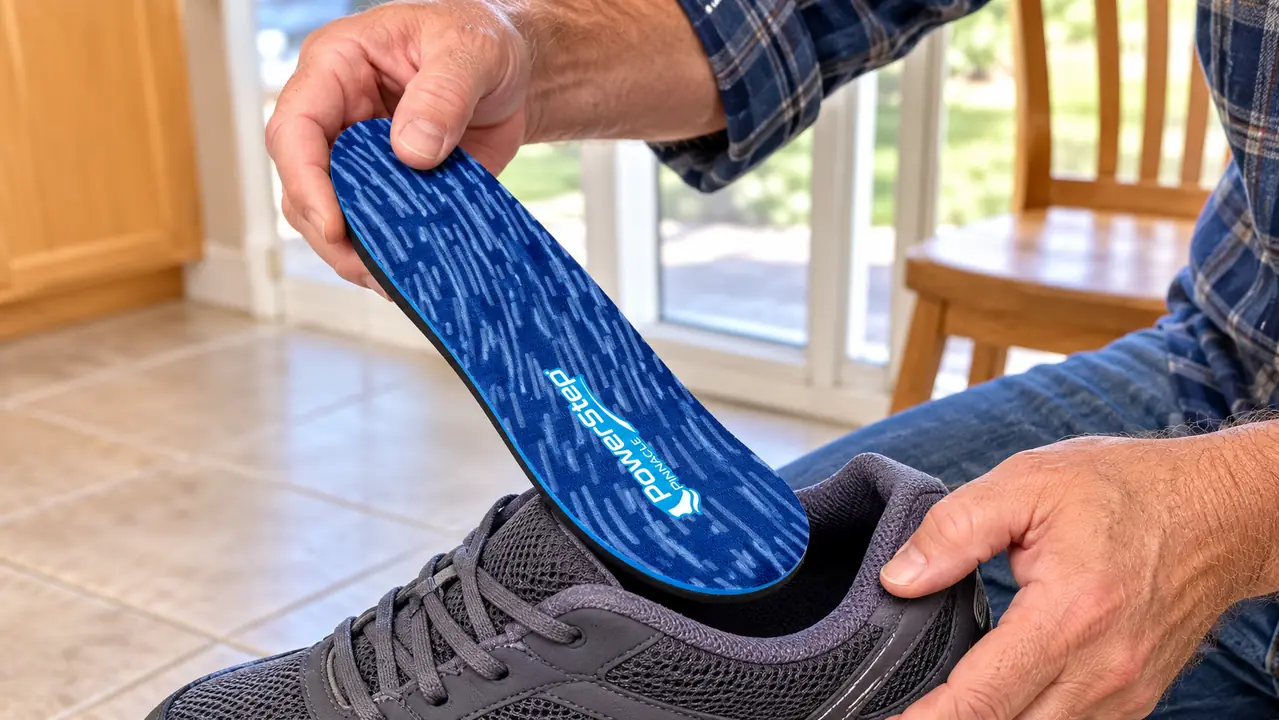
The Pinnacle is built around a semi-rigid polypropylene support shell, with a layer of EVA cushioning bonded over the top. That word, semi-rigid, is doing a lot of work. A gel insert squashes and springs back. This thing has a spine. When you press your thumb into the arch it gives a little and then stops, and that is the entire idea. In practice the insole decides where your arch sits and then holds that position through a whole shift instead of slowly flattening under you.
The catch is that your foot has been sitting wherever it sits for years, and it has opinions about being moved. Days one through four, the arch of my right foot cramped by about two in the afternoon, the way a muscle cramps when you hold it in a new position. Nothing dramatic. Just a tired, gripey feeling through the middle of the foot, and a strong urge to kick the shoes off in the car.
I did what the physical therapist told me to do with anything new, which was build up slowly. Two hours the first day. Four the next. By the end of that first week I was wearing them for a full shift, and by the end of the second the cramping was gone. My mistake the first time was wearing them for a six hour shift straight out of the box and then deciding at hour five that I had wasted my money. Give them a week before you decide anything.
How I Have Actually Used Them
My routine is not complicated. Three mornings a week I stand behind a register on a concrete floor with a thin mat over it and nothing else. Most evenings, when it is not too hot, Ray and I walk about two miles on the bayfront path. At home the floors are tile from the front door to the back, which is why I stopped going barefoot in my own house. That is the whole test environment. No gym, no running, no hiking.
What I tracked in a notebook by the bed, because I am that kind of person: how bad the first step out of bed was on a scale of one to ten, how long it took to loosen up, and whether the last hour of a shift hurt more than the first. I did that for two weeks before the insoles and then for several months after, which is the only reason I can tell you anything useful about whether they worked.
The honest result: my mornings are different. Before, the first step was a sharp stab that made me grab the door frame, and it took a good ten minutes of shuffling before I could walk normally. Now most mornings it is a dull ache that loosens in a few minutes. On a bad week it is a little worse than that, and I still have bad weeks. I still do the calf stretches and the towel curls the therapist taught me, and on the bad weeks the night splint comes back out. The insoles are one part of the routine, not the routine.
The first step out of bed went from a stab I braced for to a dull ache that loosens before I reach the bathroom.
The Semi-Rigid Shell Is the Whole Point
PowerStep describes the Pinnacle as a moderate pronation control insole. In plain language, it is built for a foot that rolls inward a little more than it should, which is most of us who have spent decades in soft shoes on hard floors. The support shell runs the full length of the foot, so the support is not just a lump under the arch. The heel sits in a slightly cupped area, and the whole thing is stiff enough that it does not collapse when you put your weight down.
The cushioning deserves credit too, and I want to be fair to it. There is real padding under the heel and through the forefoot, more than I expected from something this firm. I can feel the heel strike being softened rather than punched. That is not the same as the cushioning you get from a gel pad, and it should not be. A gel pad under a collapsing arch is a bandage on a sprained ankle. The support is what lets the tissue calm down enough to heal.
They also fit more shoes than I expected. The listing says athletic, walking and casual shoes, and that matches what I found. They went into my walking sneakers without any drama, and I moved them into a second pair for a trip to see my daughter Melissa in Atlanta without trouble. They do not belong in anything tight across the top of the foot, and they are not going into a dress shoe. Mine live in one pair of work sneakers, and that is where they stay.
What the Listing Says, Translated
The PowerStep Pinnacle comes in one full length design, sized to your shoe size, with the men's and women's ranges printed on the same box. The pair I have weighs a little over six ounces, which is heavier than a flimsy foam insert and light enough that I stopped noticing it by the second week. They are made in the United States and they carry a 30 day money back guarantee, which matters more than people think, because it means you can try them in your own shoes and send them back if your foot refuses.
The marketing line is that they are podiatrist recommended, and I have no way to audit that claim from my kitchen table. What I can tell you is that my own physical therapist did not object when I mentioned them, and she has seen more bad insoles than I have. Take that for what it is worth, which is one professional's shrug rather than a study.
Where the PowerStep Pinnacle Insoles Fall Short
First, they take up room. Any insole with a shell this substantial pushes your foot up inside the shoe, and the heel of my sneaker suddenly felt loose and sloppy. I had to sit down and re-lace everything properly, using the top eyelet, and that fixed most of it. If you have a shoe that was already snug across the instep, this will make it worse, and no amount of adjusting rescues a shoe that is a half size too small.
Second, they wear out. The shell holds its shape, but the EVA on top compresses and flattens where you put the most weight, and the fabric cover starts to look tired. Mine are at the point now, after most of a year of regular use, where I can feel the difference on the long walk days. Nobody mentions that you are signing up for a replacement every so often, the same way you replace a pair of walking shoes that have given all they have.
Third, and this is the big one, they do not fix the cause. My heel did not hurt because my shoes were bad. It hurt because I went from a soft retirement to standing on concrete for four hours, and the tissue along the bottom of my foot was not ready for it. The insoles manage the load while you build up the strength and the flexibility. Skip the stretching and the calf work and you will be right back where you started, only now with a nicer pair of insoles.
Skip the calf work and the stretching and you will be right back where you started, only now with a nicer pair of insoles.
Fourth, the trimming. The toe end carries a trim line, and you cut it with ordinary kitchen scissors. Once you have cut, you had better be sure, because a trimmed insole is not going back in the box. Trace your shoe's factory insole on a piece of paper, compare, and cut a little long rather than a little short. Five minutes of fussing saves you from an expensive mistake.
What I Liked
- Holds the arch in one position through a full shift instead of squashing flat by noon
- Real cushioning under the heel, more than the firmness would suggest
- Goes into walking, athletic and casual shoes without major adjustment
- Made in the United States, with a 30 day money back guarantee if your foot refuses
Where It Falls Short
- Takes up room inside the shoe and can cause heel slip until you re-lace
- The first week is uncomfortable while your foot adjusts to being held
- The top layer compresses and needs replacing after months of daily use
- Does nothing about the cause, so the stretches still have to happen
What I Tried Before These
I tried the drugstore route first, because it was the cheapest thing to try and I did not know any better. The gel heel cups felt wonderful for about a week and then flattened out. The full length soft inserts were comfortable in the store and useless by the end of a shift, because soft foam under a foot that is rolling inward simply compresses. I also tried a very firm pair that a coworker swore by, and those were the opposite problem. So hard that my arch ached within an hour and I gave up.
The difference with the PowerStep Pinnacle is that it sits in the middle. It is firm enough to actually support the arch and soft enough on top that it does not feel like standing on a shelf. If you are weighing them against a drugstore brand, the honest comparison comes down to whether you want a pad or a support, and those are not the same purchase.
Who This Is For
This is for the person whose heel hurts worst on the first steps out of bed and again after sitting through a long lunch. It is for anyone who stands on a hard floor for a living, whether that is a register, a warehouse, a kitchen or a hospital corridor. It is for the person who has been told they have plantar fasciitis, who has done the stretching, and who needs something to make the workday survivable while the tissue settles down. It is also for the person who just needs more support in a walking shoe and is not ready to pay for custom orthotics.
Who Should Skip It
Skip it if your pain is severe, sudden, or getting worse, because the answer to that is a doctor, not an insert from a website. Skip it if you have diabetes or circulation problems in your feet, since anything that changes pressure on the sole of the foot should be cleared with your podiatrist first. Skip it if you need something for a tight dress shoe or a boot with no removable footbed, because it will not fit and you will be annoyed. And skip it if you are not willing to give it a week, because the first few days will talk you out of it.
Where Mine Are Now
Most mornings I get up and walk to the bathroom like a person instead of a question mark. The insoles stay in the work sneakers. The foot roller stays by the couch. I still do the stretches in the kitchen while the coffee brews, and on the bad weeks the night splint comes back out. That is the shape of it. Not fixed, managed, and the PowerStep Pinnacle insoles did more for my workday than anything else I bought in 2025. I would buy them again, and I would tell anyone at the register the same thing I would tell you at my kitchen table.
Buy them for the workday, not for a cure
You will still need the stretches and the calf work. What these give you is a foot that holds its position through a shift instead of collapsing on concrete. Match the size to your shoe before you order.
Amazon Check Today's Price on Amazon →