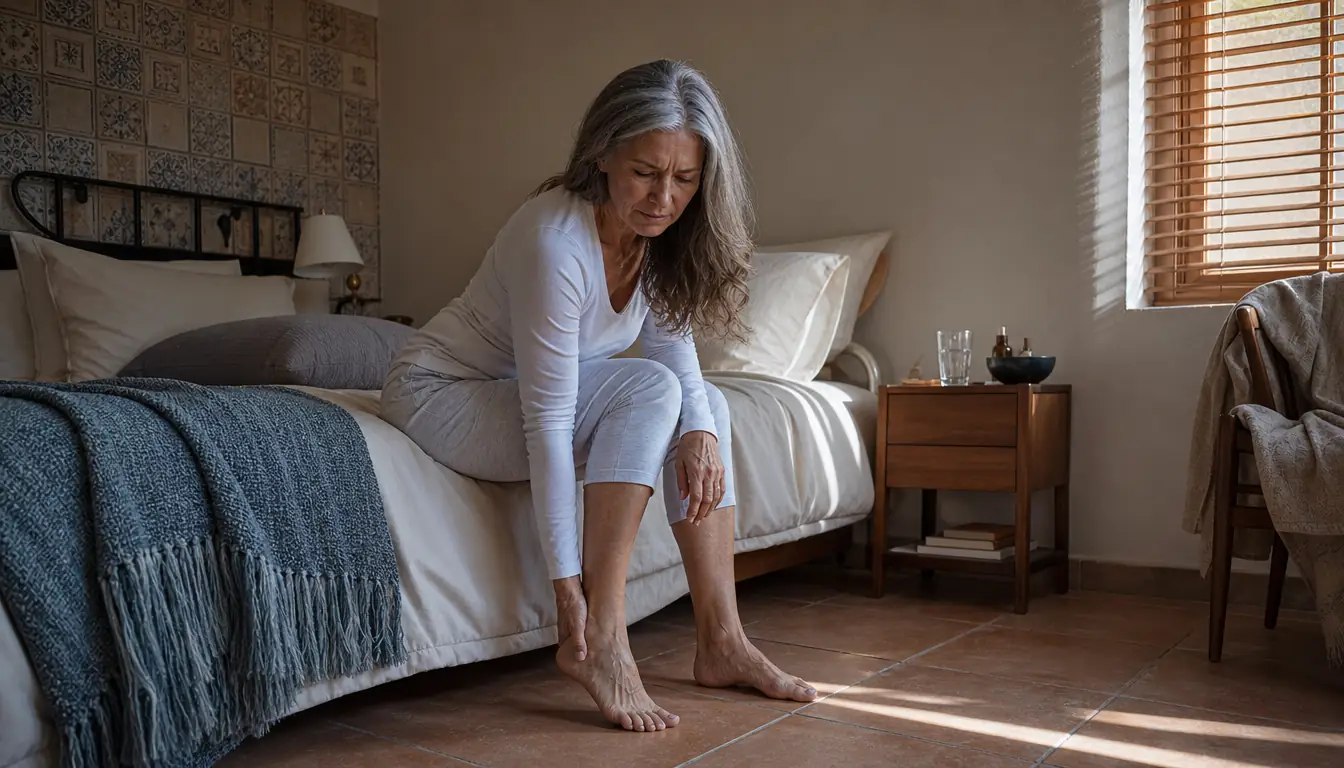
The first step out of bed was the worst part of my day for most of 2025. Right heel, sharp as a tack, and I would stand there with one hand on the dresser until it loosened up enough to walk. My primary care doctor diagnosed plantar fasciitis that spring and sent me to a physical therapist for six visits. The stretches helped. Better shoes helped. But the thing that changed my mornings was wearing a night splint while I slept, and learning how to sleep in one took me about three failed attempts. The first night I set the stretch too far and pulled the brace off at one in the morning.
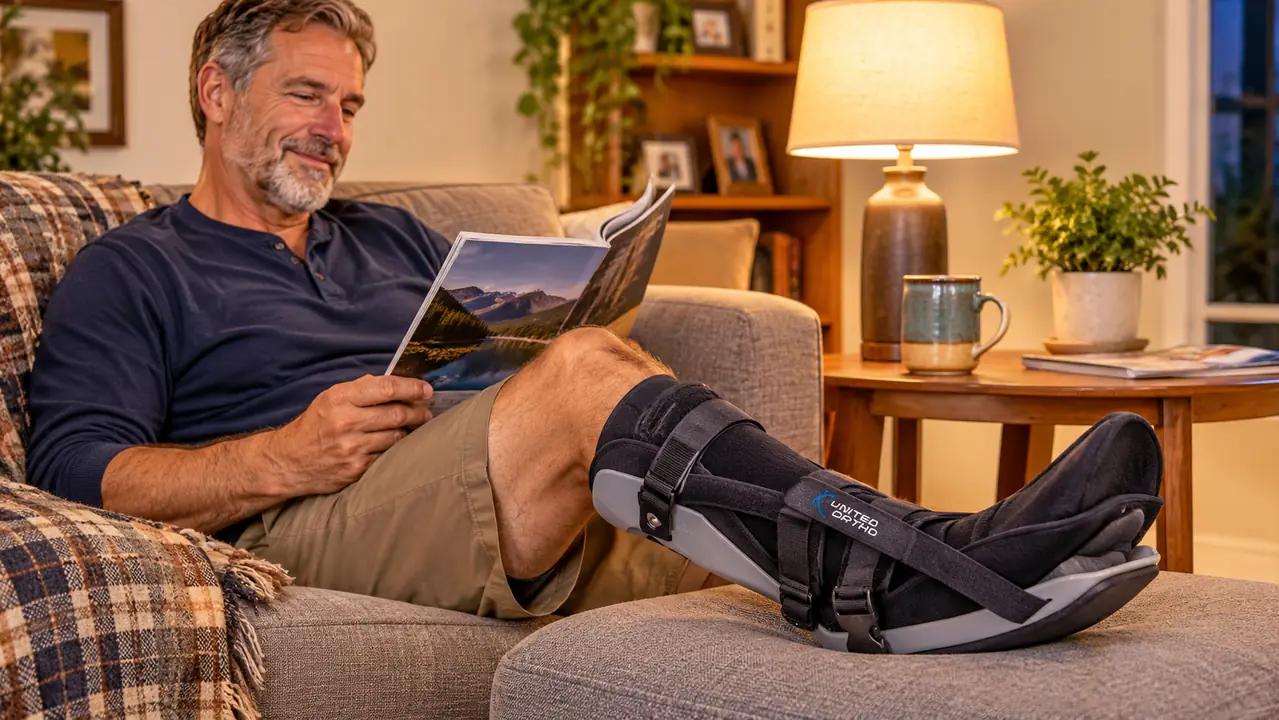
Here is the short version of what a night splint does. It holds your foot with the toes drawn gently toward your shin while you are asleep, which keeps the plantar fascia and the Achilles tendon from tightening up overnight. That is the whole idea, and it is why the first steps hurt less. The brace I use is the United Ortho adjustable leg support in size Large, and it fits either foot. It has flexion straps that set the stretch, a foam liner against the skin, and padded straps around the calf and ankle. It adjusts from 10 to 90 degrees of dorsiflexion, which sounds technical and really just means you can make the stretch as mild or as strong as you can tolerate. I am not a clinician and this is not medical advice. It is what worked on my foot, and the routine matters as much as the brace.
The Brace That Made My First Steps Bearable
An adjustable leg support that holds a gentle stretch while you sleep, with a foam liner and padded calf and ankle straps. Check the size range against your foot before you order.
Amazon Check Today's Price on Amazon →The Five Steps That Got Me Through the Night
Step 1: Measure Your Foot Before You Order Anything
The Large in the United Ortho brace fits women's shoe sizes 10 to 12.5 and men's 9.5 to 11.5. That is a wide range and it is not a suggestion, it is the fit range. Measure your foot the way the listing tells you to, or have someone help you do it, before you order. I wear a women's 10.5 wide and the Large works on my right foot with a thin sock underneath. A coworker at the garden center has a much smaller foot, and the Large would have hung off her ankle like a boot.
Fit matters more than people expect, because the straps are what do the work. The padded calf strap should sit against the meat of your calf, not up behind your knee, and the ankle strap should close without digging in anywhere. If the brace slides down your leg during the night, it is too big or the straps are too loose, and you will wake up with the stretch landing in the wrong place. Mine sits about a hand's width below the knee, and that is where it stays. If you are measuring at home, do it twice, once in the morning and once at the end of the day, because feet swell and the afternoon number is the one to trust.
One more sizing note that saved me some grief. A night splint is for sleeping and resting, not for walking around the house, and my physical therapist was clear about that. This one weighs a little over a pound, so it is not heavy, but it will shift on your leg if you are up and moving in it. Treat it like a retainer and not like a shoe.
Step 2: Start at the Gentlest Stretch, Not the Strongest
The United Ortho brace adjusts from 10 to 90 degrees, and your instinct will be to go big. Do not. Ten degrees is a light pull. Ninety is close to standing on a stair with your heel hanging off the edge. My first night I put it somewhere in the middle, and my calf cramped so hard I saw spots. The right starting point is the mildest setting where you can feel a stretch across the bottom of your foot and up the back of your leg without gritting your teeth.
Give the first week to that mild setting. You are teaching your calf to be lengthened for hours at a time, which it has never done before. On a scale of one to ten, aim for a three. If you can fall asleep at a three, you can tighten the flexion straps one small notch the following week. I moved mine up a step at a time over about three weeks and then stopped where it was, because more stretch was not buying me better mornings. More is not better here. Tolerable is better.
The pull should feel like the bottom of your foot is being gently drawn out, not like the arch is being torn. If you get a burning spot under the ball of your foot, or tingling in your toes, the angle is too steep or the straps are too tight. Loosen both, give it a night off, and start again at the gentlest setting. Numb toes are your foot asking you to stop.
Step 3: Wear It Awake for an Hour First
This is the step that saved the whole thing for me. Before you attempt a full night, put the brace on after dinner and wear it for an hour while you watch television or read. Sit with your leg out on the ottoman. Biscuit, my orange tabby, will park himself on the footrest and stare at it, and that is fine. The point is to find out how the straps feel while you are awake enough to fix them.
An hour of awake wear tells you three things. Whether the calf strap sits too high. Whether the ankle strap bites. And how the foam liner feels against bare skin after thirty minutes. If the liner starts to feel warm or clammy, either loosen the straps or put on a thin ankle sock, which is what I do. It also cuts down on the strap marks you find in the morning.
If an hour is easy, wear it for the whole evening and take it off right before bed. The jump from an evening to a full night is smaller than the jump from nothing to an evening. If an hour is not easy, you are at too steep an angle, and step two is where you go back to. There is no prize for rushing this.
Step 4: Put It On Last, After Everything Else
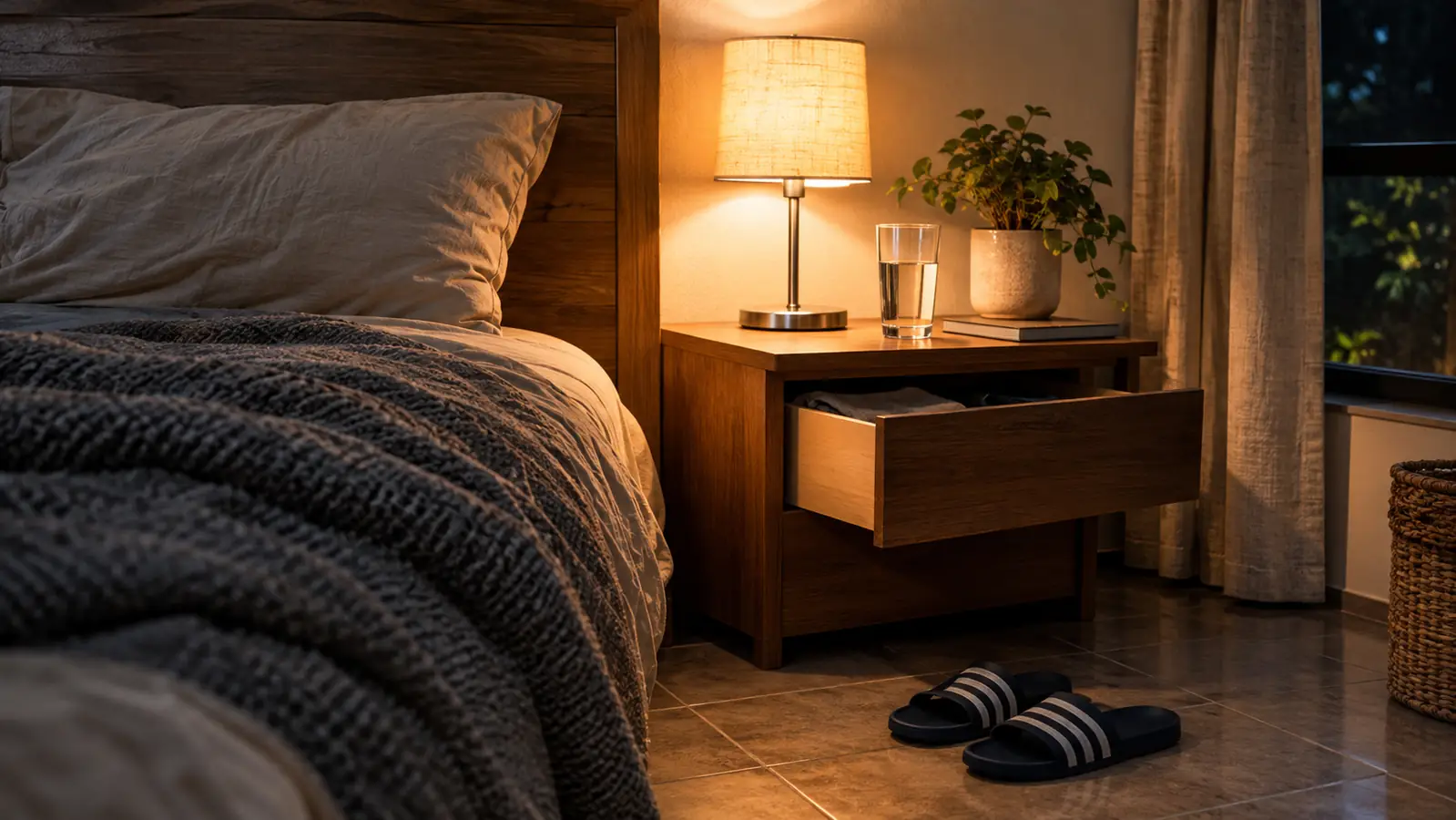
The order of operations at bedtime matters more than it should. If you put the brace on and then get up to brush your teeth and check the door locks, you will be walking around in it, and the straps will move. So do everything else first. Bathroom, teeth, water on the nightstand, cat fed, lights off. Then sit on the edge of the mattress and put the brace on as the last thing you do before you lie back.
I keep mine on the floor next to the bed with the straps already opened flat, so I am not fumbling in the dark. The padded straps close over the top of the calf and around the ankle, and the flexion straps set the angle. Once it is on, lie back and give it two or three minutes before you start deciding whether you can sleep in it. Most nights the first few minutes feel strange and then you forget it is there. I also tuck a thin pillow under my knee, which takes some of the weight of the brace off the calf strap. That was Ray's suggestion and it was a good one.
There is a mental piece to this that nobody mentions. You will spend the first night convinced you cannot possibly sleep with a brace on your leg. The second night is usually better. By the fourth or fifth night it is just part of the routine, like a retainer or a sleep mask. Give it a week before you decide it is not for you, because one bad night is not enough information.
Step 5: Plan for the 2 A.M. Problems
Almost everybody takes the brace off in the middle of the night at least once. It is not a failure and it does not mean the brace does not work. It usually means one of three things is off. If you wake with a hard cramp in your calf, the angle is too steep, so back it off a step. If the straps are leaving deep marks or the back of your ankle is sore, loosen them, and if that does not settle it, go back to a thin sock under the liner.
If you wake up needing the bathroom, take the brace off, walk in your house shoes, and put it back on when you get back into bed. Mine comes off in about four seconds once the straps are open, which is the whole reason the open flat setup from step four is worth the trouble. Learning how the straps work at two in the morning, in the dark, half asleep, is not a plan.
And if you get to three in the morning and you have had enough, take it off and go to sleep. Half a night in the brace is better than no night at all and a foul mood the next day. I still take mine off on the worst nights, usually in the second week of a bad spell when my calf is already tight to begin with. The next night I start back at the gentlest angle and build up again from there. One small tip: practice opening and closing the United Ortho straps in daylight a few times before your first full night, because fumbling with them half asleep is how people give up on the whole idea.
My first steps went from a stab to a dull ache that loosened in a few minutes. Nothing else I tried in 2025 changed that.
What Else Helps
The brace is one piece of this, not the whole thing. The single best habit I picked up from my physical therapist is stretching before my feet touch the floor. I do a towel stretch and a calf stretch while I am still sitting on the edge of the bed, and it takes about ninety seconds. I also put supportive insoles in my work sneakers, the kind that come out of the box flat, because I am on concrete for three mornings a week at the garden center. Those two changes plus the night splint are what most of my good weeks are built on.
At home I stopped going barefoot. Our whole house is tile, which is normal in Florida and unforgiving on a sore heel, so I wear slides as house shoes from the moment I get up. There is a foot roller by the couch that I use while the evening news is on, and on long shift days I wear a compression sleeve on the right foot. Ray and I still walk our two miles along the bayfront most evenings when it is not too hot. I just do it in proper sneakers instead of whatever was by the door.
The other thing that helps is boring consistency. A night splint works because it holds a stretch for hours while you are not paying attention. Skip three nights in a row and my mornings remind me within two days. I aim for five nights a week in a normal week and seven when the heel is acting up. That is not discipline, it is just the shape of the routine now, and it costs me about a minute at bedtime.
One more thing, and I mean this kindly. If your heel pain is severe, came on suddenly, or has not improved after a few weeks of consistent work, go see a doctor or a podiatrist. Plantar fasciitis is the most common cause of this kind of pain, not the only cause, and there are other things that need a different approach. I waited almost two months before I mentioned it, which was two months of mornings I could have spent better.
Start With One Night, Not Seven
Set the flexion straps mild, put the brace on last, and give it a week before you judge it. The size range is women's 10 to 12.5 and men's 9.5 to 11.5, so measure first.
Amazon Check Today's Price on Amazon →