
For the first three months at the garden center I assumed the concrete floor was something you eventually got used to. I would ring up a cart full of pansies, hand over the receipt, and somewhere around the fourth hour my right heel would start to feel like there was a pebble wedged under it. There was no pebble. There was just me at sixty-four, standing in one spot for a six hour shift, wondering how the women who had worked that register for twenty years managed it. The answer, it turns out, is that some of them did not manage it. They just never said anything.
I have plantar fasciitis in that right heel. My doctor diagnosed it in the spring of 2025 and sent me to a physical therapist for six visits, and the calf stretches and towel pulls she taught me are still part of my morning. But for the standing itself, the part nobody warns you about, the thing that helped most was a footless compression sleeve. The one I settled on is made by BLITZU, and I have worn it on long shift days for most of a year now. It is not a cure. It is one layer in a routine, and this is where that layer fits into the day, in the order I actually do it.
The Layer That Gets Me Through a Six Hour Shift
Footless compression that covers the arch, heel and ankle and leaves the toes out in the open. Mine goes on before I leave the house, not after the pain shows up.
Amazon Check Today's Price on Amazon →Step 1: Put It On Before You Leave the House
The biggest change I made was timing. For a while I kept the sleeve in my bag and put it on at lunch, once the heel had already started talking to me, and by then it never did much good. Now it goes on while I am still sitting on the edge of the bed with my coffee, before I have walked out to the kitchen. The compression is there from the first step of the day to the last one, and that seems to be the difference between a shift I finish and a shift I limp through. If you take one thing from this article, take that one.
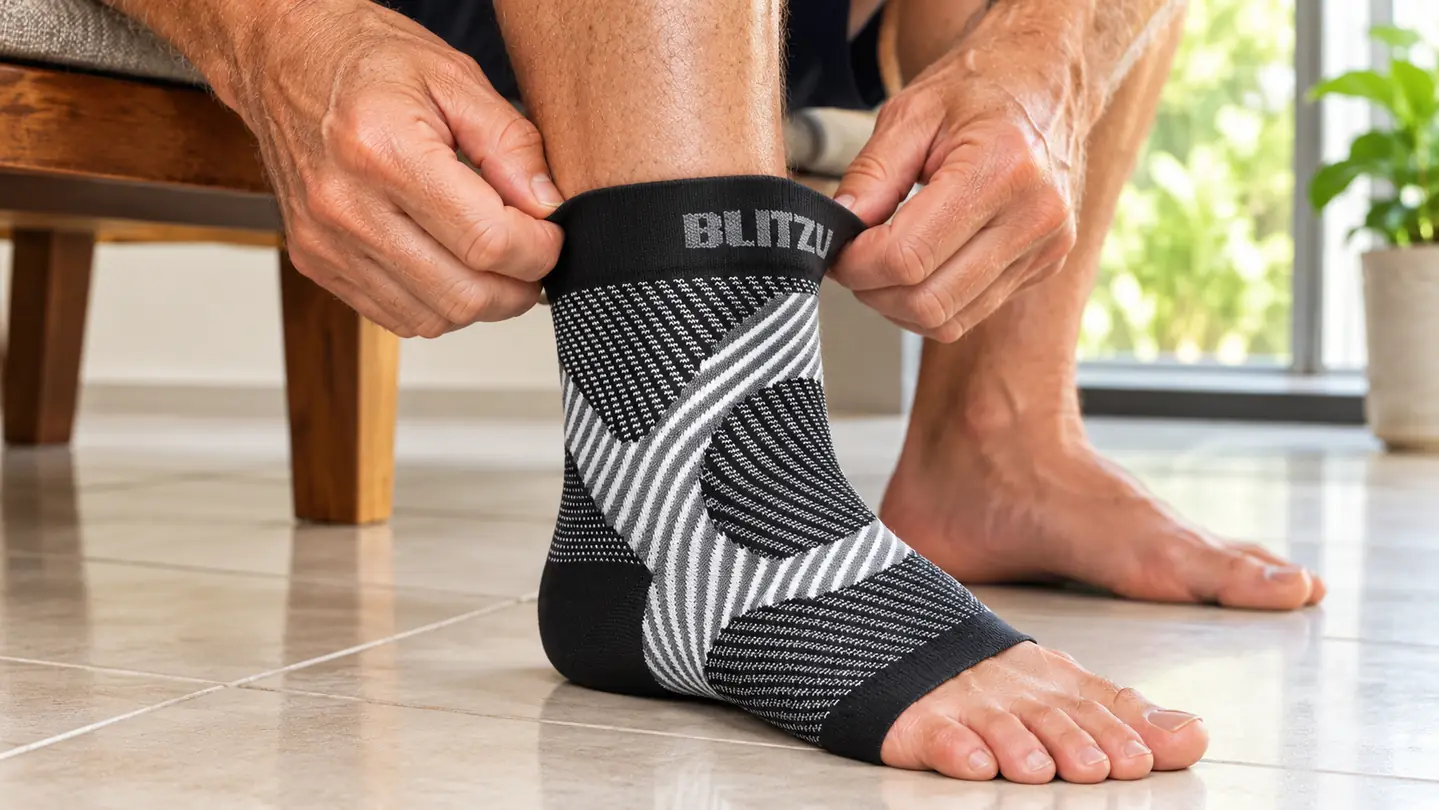
It is a pull on sleeve, and it takes about twenty seconds. I roll the BLITZU sleeve up over the foot the way you would a thick sock, then settle it so it sits over the arch and the heel and around the ankle. The toes stay out in the open. That part matters to me more than I expected. Years of wearing regular socks in Florida heat had already made me fussy about my feet, and with the toes free there is nothing pinching or rubbing all morning, and nothing trapping the sweat on a ninety degree day behind the register.
The nylon is thin enough that I forget about it once my shoe is on. On the kitchen scale it comes in at about two ounces, which is nothing, and it does not add bulk inside my sneaker. It goes into the washing machine with the rest of the laundry at the end of the week, and that is the only reason I have managed to keep up with it. Anything that needs hand washing does not survive a garden center schedule, and I know that about myself by now.
Step 2: Check the Fit Before You Decide It Does Not Work
My first order was the wrong size and I nearly gave up on the whole idea. I had guessed, and guessing is a bad plan in a pull on sleeve because there is no strap to loosen and no way to adjust the thing once it is on your foot. I ordered the 2X-Large the second time, which is the size on my package. When it arrived, the sleeve felt firm and even all the way around instead of pinching in one spot, and I realized the first one had not failed me. I had failed it.
A good fit feels snug without biting. It should sit flat under the arch with no wrinkle bunched up in the middle of your foot, and the top edge should stay where you put it instead of rolling down every time you take a step. Two tests I use: if your toes go numb, it is too tight. If you take it off at the end of the day and the mark on your ankle is still visible an hour later, it is too tight. Folding the top down to make it feel better only makes it worse, because now you have added a second edge to press on your skin.
Give it three or four shifts before you form an opinion. The first day I was aware of it constantly, the way you are aware of a new pair of glasses for the first hour. By the second week I was putting it on without thinking about it, and only noticing it when I took it off and felt the difference in the last twenty steps to the car.
Step 3: Fix the Shoe and the Insole First
A compression sleeve cannot rescue a bad shoe, and I want to be plain about that because it is the mistake I see people make. If you are standing on concrete in thin flat shoes for six hours, no sleeve is going to fix your heel. I wear one pair of supportive walking sneakers to work and nothing else, and I replace them when the heel cushion goes flat. That single habit did as much for me as the sleeve did, and it cost me nothing but attention.
The sleeve works as part of a stack. In my case the stack is a PowerStep Pinnacle insole inside the shoe, the BLITZU sleeve on my foot, and then the whole arrangement inside the sneaker. Order matters. The insole goes in first, the sleeve goes on second, and then I put my foot in slowly so the sleeve does not bunch at the heel. If I rush that last part I feel it by noon. It is a fifteen second job done properly and a five second job done wrong.
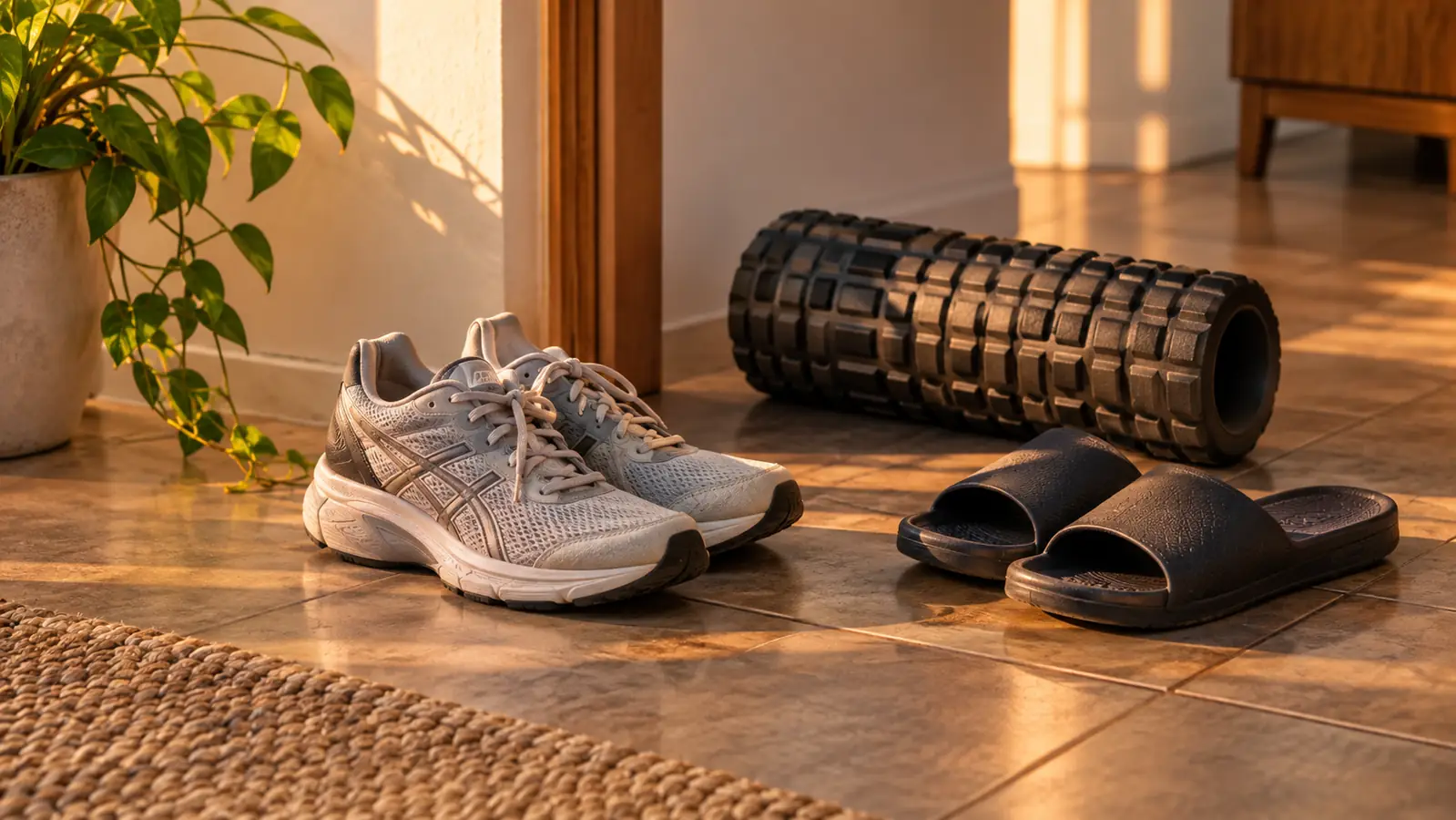
The other half of this step is subtraction. I stopped wearing backless shoes for a full shift. I stopped wearing thin flats to the grocery store. Most of all, I stopped walking around my own house barefoot. Our house is tile from the front door to the back, and bare feet on tile at six in the morning is the worst thing I can do to that heel. The slides live by the bed now, and my bare feet touch the floor about twice a day.
Step 4: Build a Five Minute Reset Into the Middle of the Shift
Standing still is worse than standing and moving. On a busy Saturday I can stand in one spot for an hour ringing people up, and that heel will throb in a way it never does when I am walking the aisles putting things back where they belong. So I ask for my break around the three hour mark, and I sit down. I eat something. I drink water. It is not a luxury I am negotiating for, it is part of the job now, and I have never had a manager argue with me about it.
The reset itself is small. Shoes off, sleeve off, toes wiggled. Then the calf stretch the physical therapist taught me, with my hands on a wall or on the side of the building outside: back leg straight, heel pressed to the ground, hold it for thirty seconds on each side. On a rough week I roll the arch of my foot over a frozen bottle of water for a couple of minutes. Then the sleeve goes back on and I go back out onto the floor.
The other thing I do is change position whenever I can get away with it. There is a low stool behind the register and I put one foot up on it for a few minutes at a time, then switch. Nobody has ever said a word about it. Small changes in the way you stand add up across six hours, and they add up quietly, without you noticing until the end of the day when you realize your heel is not screaming at you the way it used to.
Step 5: Take It Off Right and Treat the Evening Like It Matters
The BLITZU sleeve comes off when I get home, not when I go to bed. My skin wants the air after six hours, and I do not believe that wearing compression around the clock does anybody any favors. It goes into the laundry basket, and the OOFOS slides go on before my bare feet touch the tile. That swap is a small ceremony now. Shoes off, slides on, kettle on, cat fed. Biscuit supervises the whole thing.
Evenings are where the rest of the routine lives. The massage roller stays by the couch and I use it while the news is on, which is the only way I have ever stuck with anything. On a bad week the night splint goes on the right foot before bed, and that is the thing that makes the first steps out of bed bearable instead of sharp. On a good week I leave it in the closet and I do not feel guilty about that either.
Ray and I walk about two miles on the bayfront path most evenings when it is not too hot. I kept that up through all of this. But I will skip it on a day when the heel is angry, and I have stopped feeling like a quitter about it. Walking is good for plantar fasciitis. Walking on a bad day is not, and the difference between those two things took me an embarrassingly long time to learn.
What Else Helps
The sleeve is one piece of a kit, and I would be lying if I said it was the whole answer. The night splint does more for my mornings than anything else I own. The insoles do more for the middle of the shift. The roller and the stretches keep the bad weeks shorter and further apart. The BLITZU sleeve is the piece that gets me through the hours when I am on my feet and cannot sit down, which for a cashier is most of them. Alone, none of these is enough. Together they have given me back a job I actually like.
What also helps is knowing when to stop treating it at home. My doctor was clear with me and I will pass it along: if the pain is severe, if it comes on suddenly, if there is numbness or tingling in the foot, or if nothing you are doing makes a difference after a few weeks, go see a podiatrist. Plantar fasciitis is common and it is treatable, but it is not something to guess at for a year the way I did before I finally picked up the phone and made the appointment.
One more thing and then I will get off my soapbox. None of this gear costs what I expected it to, but none of it works if you buy it and leave it in the bag. The sleeve is machine washable and takes twenty seconds to put on, which means there is no good excuse not to use it. I have watched people buy a night splint, wear it twice, and declare the whole thing useless. The people I know who actually got better are the ones who were boring about it. Same routine, every shift, for months.
The sleeve never made the pain disappear. What it did was turn a six hour shift on concrete into something I could finish and still walk to the car.
For Anyone on Concrete All Day, Start With the Simplest Layer
A pull on sleeve, machine washable, about two ounces. Wear it before the shift starts, size it properly, and give it a full week before you decide.
Amazon Check Today's Price on Amazon →