
Three mornings a week I stand behind a register at a garden center on the Gulf Coast of Florida, and the floor under my feet is concrete stained to look like stone. Nobody mentions the concrete when they hand you the apron. I started that job in early 2025, a couple of years after retiring from 31 years of teaching elementary school, and by March my right heel had a spot in it that felt like a small pebble I could never find, never rub out, and never quite ignore.
Plantar fasciitis, my doctor said that spring. She sent me to a physical therapist for six visits and gave me a short list of things to try at home. I worked through that list slowly and with a fair amount of doubt. Insoles first, then a night splint for the bad weeks, a roller I keep by the couch, and a pair of recovery slides because every floor in this house is tile. By summer I added a compression sleeve I bought myself. The BLITZU foot compression sleeve is the one that ended up living in my work bag, and months later it is still there. What follows is what it has honestly done for me, and where it has come up short.
The Quick Verdict
Not a cure, and no replacement for the stretches my physical therapist gave me. But on long concrete shifts the BLITZU sleeve keeps my right arch from stiffening into that deep ache by noon, and that is worth the drawer space.
Amazon Check Today's Price →The sleeve that lives in my work bag, on shift days and off
If your heel starts talking to you two hours into a shift, this is the piece of gear I would reach for first. Current price and the size chart are on the product page.
Amazon Check Today's Price on Amazon →How I've Used It
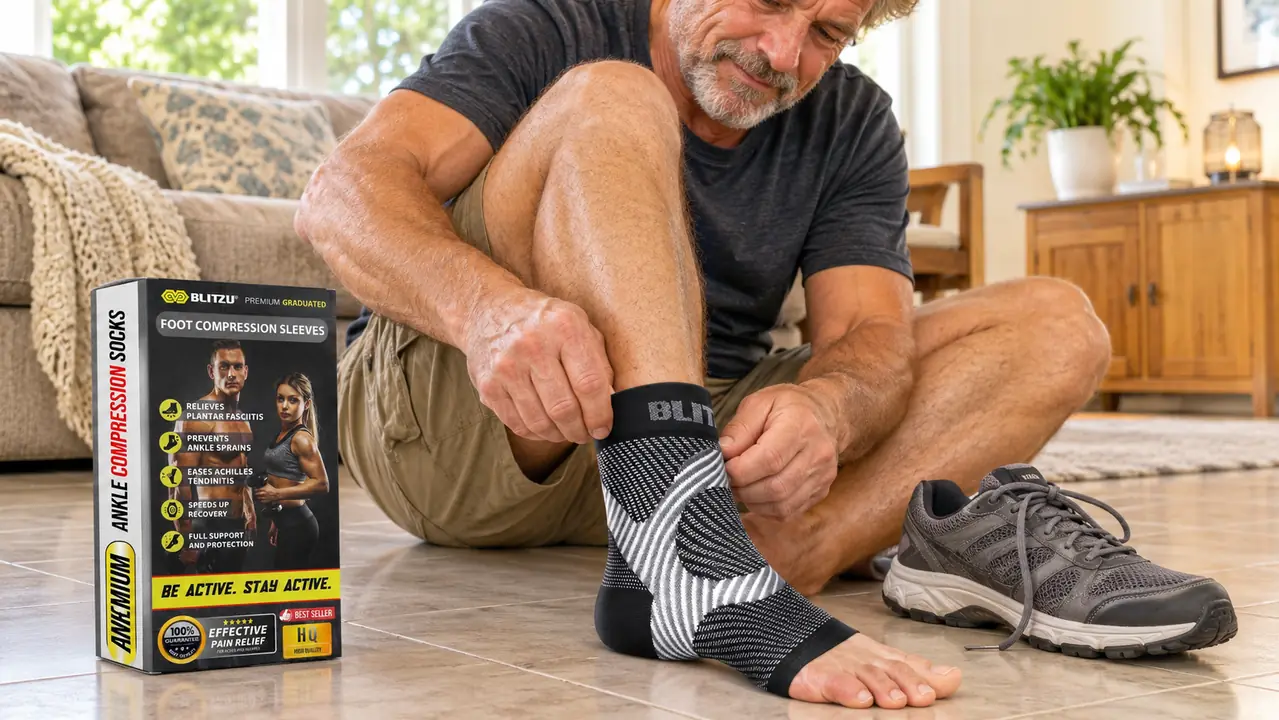
I bought a pair in July 2025 and started with the right foot only, since the left one has never done more than ache a little on a long day. My routine is boring and it has not changed since. I put the sleeve on at the house before my sneakers, drive to work, and it stays on until I am home and changed out of my work clothes. It is a pull-on sleeve. No zipper to fight, no straps to readjust in the middle of a rush of customers who all want to pay at once. I wear it under a thin sock, inside the same pair of supportive walking sneakers I wear for every shift, with my PowerStep Pinnacle insoles still sitting in the bottom of them.
At the end of the week I wash it in the machine with the rest of the laundry and let it air dry over the back of a kitchen chair. It is nylon, thin, and the pair weighs almost nothing, about two ounces, so it does not crowd the shoe or make my foot feel packed in like a sausage. The first two days I was aware of it every single minute. By day four I forgot I had it on, which is the highest compliment I can pay anything you wear.
On my off days I usually skip it. Ray and I walk about two miles along the bayfront path most evenings once the heat backs off, and I will put the sleeve on for that walk if the morning started badly. Otherwise it stays in the bag by the door, waiting for the next shift.
One thing I did not expect: the sleeve is the reason I stopped keeping a spare pair of flats under the counter. Through June I had a soft pair of slip-ons back there for the last hour of a shift, and I would swap into them the moment the register line died down. I have not touched them since August. Whether that is the compression or just a good stretch of weeks, I cannot say for certain, but I noticed the change and I am not going to argue with it.
What the Sleeve Actually Is
It is a footless sleeve, which is the detail that made me buy it in the first place. It pulls on over the arch and the ankle and stops short of the toes, so nothing bunches up between them and nothing rubs. It comes as a pair in the 2X-Large size I ordered. There is no arch support built into it, no plastic shank, no heel cup. It is compression and not much else, and I think that is exactly why it layers so well with the insoles I already trust.
That distinction matters more than it sounds. An insole changes how your foot lands on the floor. A sleeve just hugs the foot and the ankle, and for me the hugging is what keeps the arch from feeling tired and puffy by the end of a shift. The BLITZU sleeve did not replace anything in my routine. It filled the gap between the things that treat a foot and the things that get you through a Tuesday.
It also does not replace the night splint. That stays by the bed on the bad weeks, holding the right foot at an angle overnight so the first steps in the morning are not the worst part of my day. The sleeve is a daytime tool. I learned that the hard way by trying to sleep in it once, and I do not recommend the experiment.
What Was Already in the Routine
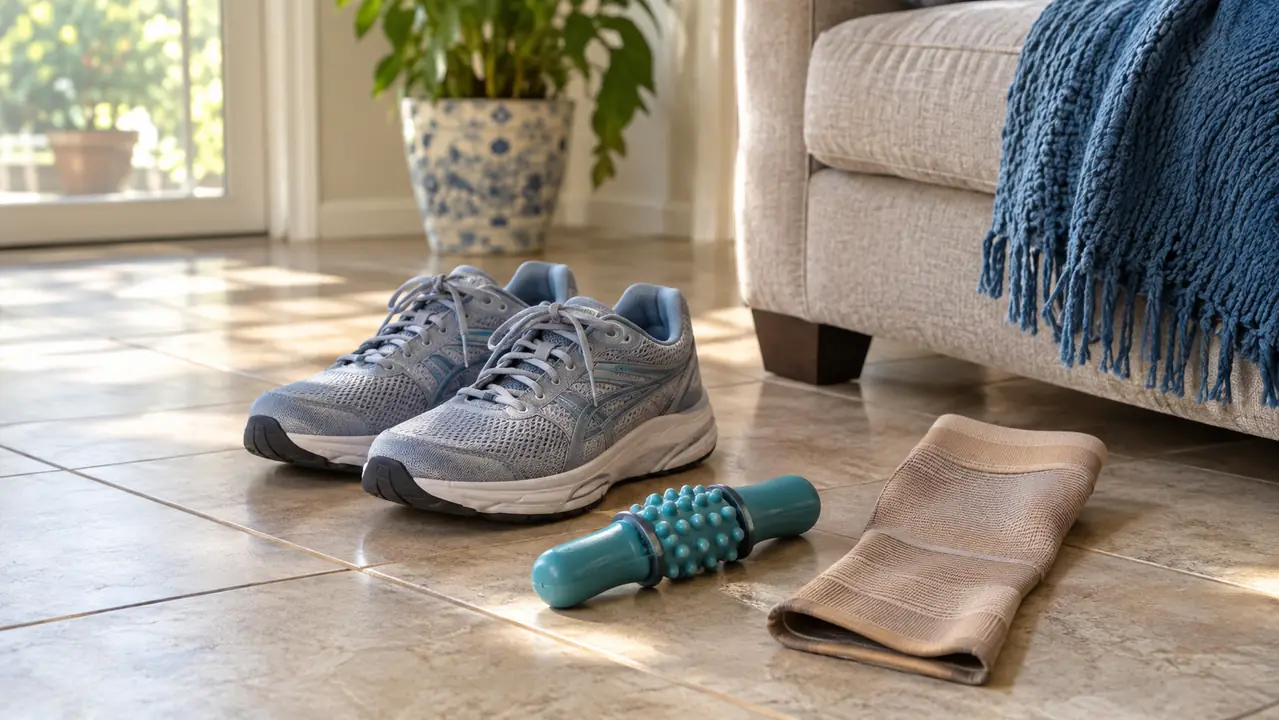
I want to be straight about the order of things, because a sleeve alone did not get me from March to now. The insoles came first, on the advice of my physical therapist, and they are the reason I can stand at all. The night splint came next and I hated it for two weeks and then stopped noticing it. The roller by the couch is the cheapest thing in the house and I use it while the news is on. The slides were Ray's idea, after he watched me hobble across the tile in bare feet one too many times.
So the sleeve was the last piece, not the first. I bought it because the last hour of a shift kept going bad even with everything else in place. Standing still behind a register is harder on my heel than walking the length of the greenhouse, which surprised me. The compression is what made that standing tolerable rather than something I braced for on the drive in.
To be plain about the insoles: they were not optional. My physical therapist watched me walk down the hallway at the clinic, asked me to take my shoes off, and told me the arch on the right foot was rolling inward with every step. The PowerStep pair went into my work sneakers that week and has stayed there since. When the sleeve arrived, it went on top of that arrangement, not instead of it.
What Changed Over the Months
Month one was mostly a test of whether I would keep bothering. The compression felt snug and slightly strange, and I had to talk myself into putting it on at 6:40 in the morning when I was still half asleep. Month two, I noticed the change at the end of a shift. That used to be the hour when my heel would start up with a deep ache that sent me to the stool in the back room with my shoe off. With the sleeve on, the ache arrived later and quieter, and some days it did not arrive at all.
Month four and onward, it is simply part of getting dressed for work, the same way the insoles are. I would like to tell you my heel is fixed. It is not. Most mornings now start with a dull ache that loosens after a few minutes rather than the sharp stab it used to be, and I still have good weeks and bad weeks. Some of that is the sleeve. Some of it is the stretching my physical therapist taught me, done faithfully on the kitchen counter every morning. Some of it is just time passing. I cannot separate those out for you, and I will not pretend I can.
There was a Saturday in October that sums it up. The garden center runs a fall festival, the lot fills by nine, and I worked the register from open to close with one break at noon. A year ago a day like that would have ended with me on the couch with ice and a bad mood. I wore the BLITZU sleeve from the house that morning, and I drove home, ate supper and walked the bayfront with Ray. My heel ached. It did not stop me. That is the honest size of the thing.
What I can tell you is that I bought a second pair, and the first one has come through months of washing without stretching out or losing its grip on the foot. For something this simple, that is a fair run.
Where It Helps and Where It Doesn't
It helps most on the concrete. That is the whole reason I keep it. Three mornings of standing, walking, lifting flats of annuals, and the difference between a shift with the sleeve and a shift without it is the difference between driving home merely tired and driving home with my shoe off and my right foot propped on the dashboard. It helps on the evening walks too, when the day has already been long and the bayfront path is the only thing standing between me and the couch.
It does not help the first steps out of bed. Nothing about a daytime sleeve touches that, and anyone who tells you otherwise is selling something. It does not help much around the house either, because I am either barefoot or in my slides on the tile, and a sleeve under a slide feels like too much shoe for the living room. And it will not fix a heel that has never been looked at by a doctor. If your pain is severe, if it came on suddenly, or if it has not improved after a few weeks of sensible home care, go get it checked. Mine was diagnosed, and that mattered more than any product I have bought since.
Sizing, and the Fit Question
I ordered the 2X-Large. My feet are wide across the ball, and I would rather have a sleeve that is a little generous than one that leaves a mark I can still see at dinner. It pulls on firmly and stays where I put it, and it has never rolled down around my ankle in the middle of a shift. If you are between sizes, measure your foot instead of guessing, because this is not a garment where guessing works out.
I measured at the end of the day, standing, with my weight on the foot, which is what the size chart asks for. My right foot traced a little longer than my left, which I had never noticed in sixty-four years of buying shoes. Order from the larger measurement. A sleeve that fits the smaller foot will fight you on the bigger one all shift long.
The thing to watch is tightness. Compression should feel like a firm hug, not like a tourniquet. If your toes go cold, if the skin below the sleeve looks dented or pale after twenty minutes, or if the foot throbs when you take it off, it is too tight. Size up or stop wearing it. I am not a clinician and I am not going to dress up a sleeve as medical care. Mine is one piece of a routine that my doctor and my physical therapist put together, and it earns its place in that routine, nothing more.
What I Liked
- Keeps the right arch from stiffening into a deep ache on long concrete shifts
- Footless design means nothing bunches up between the toes
- Thin enough to wear under a sock and inside a normal walking sneaker
- Pull-on, so there is nothing to adjust halfway through a shift
- Machine washable, and it has held its shape for months
- Simple enough to slot into a routine that already has insoles, a splint and a roller
Where It Falls Short
- Does nothing for the first steps out of bed in the morning
- No arch support built in, so it is not a stand-in for insoles
- Get the size wrong and it is useless, and too tight is genuinely unpleasant
- Feels like too much under house shoes on tile floors
- It manages a long day, it does not fix the fascia
It did not fix my heel. What it did was get me through the last hour of a shift without that deep ache that used to send me to the stool in the back room.
Who This Is For
This is for the person who stands on a hard floor for a living and has a heel that starts complaining before lunch. Cashiers, nurses, warehouse staff, cafeteria workers, the woman who walks into a building at eight in the morning and does not sit down again until it is over. It is also for the person who has already done the sensible things, the doctor visit, the insoles, the stretching, and just needs one more layer that makes the day survivable. If you are 45 or 75 and your feet have started to feel their age on a floor that never gives, you are exactly who I had in mind when I sat down to write this.
Who Should Skip It
Skip it if you have not had the pain looked at, especially if it came on suddenly or it is severe, because a sleeve can mask a problem you ought to be treating. Skip it if you have circulation problems or nerve damage in your feet, or if a doctor has told you to avoid compression, because this is not the thing to experiment with on your own. Skip it if what you actually need is arch support, since that is an insole's job and this is not an insole. And skip it if you are hoping for a cure. There is no cure in a sleeve, mine included. What there is, on a good day, is a shift that ends with you still on your feet.
One more layer for the days that run long
My routine is insoles, morning stretches, a night splint on the bad weeks, and this sleeve on shift days. If you want to try the last piece, the current price and the size chart are on the product page.
Amazon Check Today's Price on Amazon →