The short answer first, since that is why you clicked. For heel pain that is worst on the first steps out of bed, the BLITZU foot compression sleeve is the one I reach for on long shift days. For a whole foot that swells and aches by four in the afternoon, PAPLUS compression socks are built for a different job. They are not two versions of the same product, and once I stopped treating them that way I stopped wasting money on the wrong one.
I am sixty-four. I taught third grade for thirty-one years, and now I work three mornings a week as a cashier at a garden center on the Gulf Coast of Florida. Concrete floor, no mat, and more steps before lunch than I used to take in a whole day of teaching. My right heel started complaining in early 2025. My doctor diagnosed plantar fasciitis that spring and sent me to a physical therapist for six visits, and I still do the calf and towel stretches he taught me. Along the way I bought a lot of things. The BLITZU sleeve went into my dresser drawer in 2025 and it is still there. I have also worn full compression socks, PAPLUS among them, on the days when the swelling sat in my whole foot instead of just the heel.
| BLITZU foot compression sleeve | PAPLUS compression socks | |
|---|---|---|
| What it covers | Footless sleeve that wraps the arch, the ankle and the bottom of the heel. Toes and the top of the foot stay bare. | A full sock, toe to lower calf. |
| How high it reaches | Stops at the ankle. | Runs up over the ankle onto the lower calf. |
| Toes and top of foot | Left free, so nothing rubs between the toes and nothing presses on the top of the foot. | Covered in fabric like any other sock. |
| Getting it on in the morning | Pulls on like a sleeve, no heel to work it over. I can manage it sitting on the edge of the bed before the heel has loosened up. | A full sock, so it has to be worked over the heel and up the foot. On a bad morning that is a project. |
| Wearing it with your work shoes | Goes over your everyday sock, and my PowerStep insole still fits in the sneaker. | Replaces your everyday sock, so it is one layer instead of two. |
| Care | Machine wash, per the listing. I toss mine in with the towels. | Follow the label on the pair you buy. |
| Best for | Heel and arch pain on days you are on your feet for hours. | Whole-foot swelling and tired legs by the end of the day. |
Where BLITZU Wins
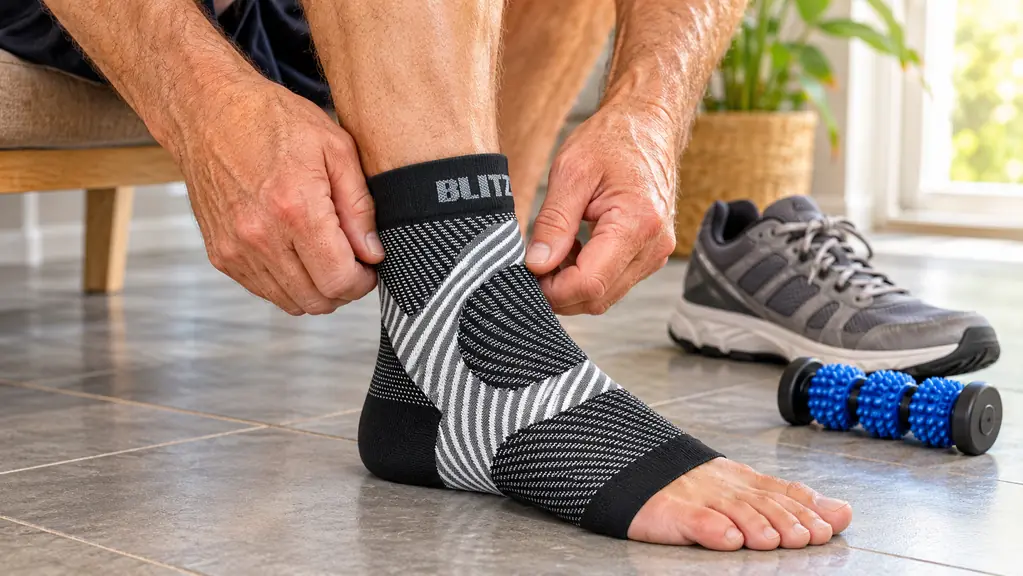
The first thing BLITZU gets right is that it is footless. That sounds like a small detail until you have a sore heel and a pair of toes that do not want anything between them. The sleeve wraps the arch and the ankle and leaves the toes and the top of the foot alone. I wear it over a thin everyday sock, and nothing bunches up under the ball of my foot, which is more than I can say for some of the full socks I tried. I have a wide foot and a high instep, and every full sock I have owned has either pulled tight across the top of my foot or gone baggy at the toe. The sleeve sidesteps both problems because it is not over either place. The listing calls it a pull-on, and that is exactly what it is.
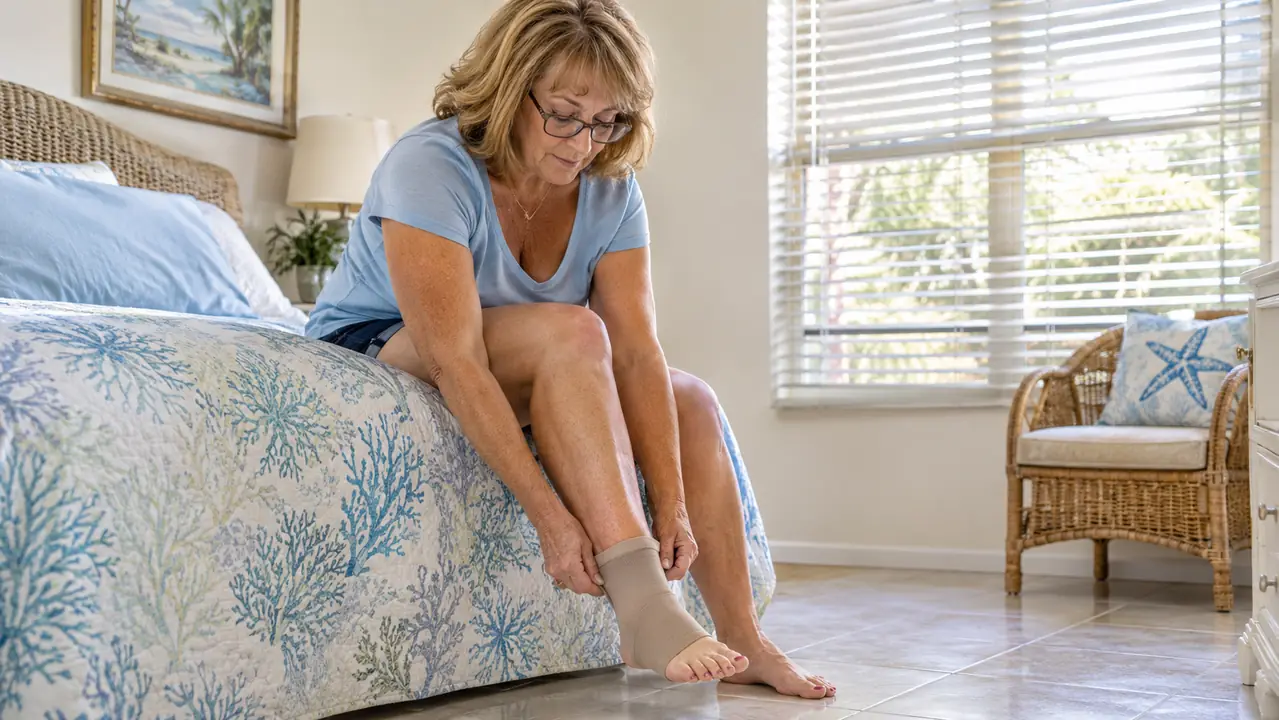
The second thing is that I can get it on at six in the morning, half awake, before the heel has loosened up. That matters more than people who have never had this problem realize. On a bad morning I do not want to be wrestling fabric over my heel and up my calf while the first sharp stab is still going on. I sit on the edge of the bed, pull the sleeve on, stand up, and get on with it. My husband Ray sets the coffee maker the night before for the same reason, and I think it is the same idea. The pair I have is a 2X-Large, and it weighs about two ounces, so it does not add bulk inside my walking sneaker. My insole still fits. When I first started dealing with this I bought a pair of full compression socks from a big box store, and I gave up on them inside a week, because getting them on was a five minute job that left me out of breath and the heel sore before I had even left the bedroom. The sleeve takes me about fifteen seconds.
The listing says it is made for targeted compression at the foot, arch and ankle, and that matches what I feel, which is a steady squeeze across the arch rather than a squeeze everywhere. It has more than forty thousand ratings and sits at 4.3 stars, so I am clearly not the only person who found a use for it. It is nylon, and it is machine washable, which is the test every piece of foot gear eventually has to pass with me. If it needs hand washing in cold water and a prayer, it does not survive a garden center schedule.
There was a Tuesday in July that made the case for me. We took a delivery of mulch and I spent the morning walking back and forth between the register and the loading area, mostly on concrete, and by eleven I had that familiar hot ache starting under my right heel. I had put the sleeve on that morning out of habit, the way I put on my glasses. At two in the afternoon it was still just an ache, the kind you notice and then forget about for twenty minutes. The summer before, that same kind of morning would have had me in the back room with my shoe off and a bag of frozen peas on my arch. I am not going to tell you the sleeve fixed anything. I am telling you what the day looked like.
Where PAPLUS Wins
Full compression socks win on coverage, and I am not going to pretend otherwise. A sock goes from the toes up over the ankle and onto the lower calf, so the whole foot gets the squeeze instead of just the arch and heel. On the afternoons when my foot is puffy from the toes back, not just sore at the heel, the sock is the better shape for the job. My sleeve does nothing for the top of my foot or my toes, because it is not over them. When the swelling has crept up to the ankle bone, the sleeve stops right where the problem starts.
They also win on simplicity, in a way. A sock replaces the sock you were going to put on anyway. One layer, done. My sleeve goes over a sock, so on a hot Florida morning I am wearing two layers below the ankle, and by August that is a real consideration. And on days when the ache runs up past the ankle bone, a sock at least addresses the whole area. The tradeoff is real, though. Getting a full compression sock over a tender heel at six in the morning is slower work than pulling on a sleeve, and on my worst mornings I would have skipped it entirely. There was a Saturday in June when Ray and I did our two miles on the bayfront and my whole foot, toes and all, felt like it had been filled with sand by the time we got back to the car. I put the socks on when we got home and sat with my feet up for half an hour, and that was the right tool for that evening, no question.
What I Noticed After a Month of Going Back and Forth
I started paying attention to which one I actually reached for, rather than which one I thought was better in theory. For about six weeks I kept a note on the kitchen counter and marked a letter every morning. S for sleeve, K for sock, N for neither. Out of eighteen garden center shifts in that stretch, eleven were sleeves and four were socks. The other three were neither, which tells you something honest about all of this. Some mornings I was running late, put on my sneakers and went, and the foot survived anyway. The pattern in those marks was simple. On garden center mornings, when I knew I would be standing at a register and walking the lot for six hours, I reached for the sleeve. On a Saturday when Ray and I walked two miles on the bayfront path and my whole foot felt heavy afterward, the socks were the better choice that evening. Different days, different problem.
The honest part is that neither one does anything dramatic. Neither of them is treating the fascia. What the sleeve does is make hour five of a six-hour shift feel closer to hour two. That is the whole promise, and it is enough for me to keep wearing it. I still do my stretches. I still wear my supportive sneakers with the PowerStep insoles in them, and I still wear my OOFOS slides on the tile at home instead of going barefoot. The sleeve is one small piece of a routine, not a replacement for one.
The sleeve does not heal the fascia. What it does is make hour five of a six-hour shift feel closer to hour two, and that is the point of it.
One practical note after a few months of this. I take the sleeve off when I get home and roll my arch on the BESKAR roller by the couch for a few minutes before I do anything else. If I leave the sleeve on and sit down for an hour, my foot feels stiff when I stand back up, sock or sleeve, either way. Compression while you are up and moving is the useful part for me. Compression while you are parked in a chair watching the evening news is not doing much. The other thing I learned is that the sleeve has a limit. By hour seven or eight it has done what it is going to do, and the honest answer at that point is to sit down and get off the concrete for ten minutes. Nothing you pull onto your foot replaces a break.
The sleeve I keep in the drawer for shift days
Footless, pull-on, machine wash, and sized up to 2XL. It goes over your everyday sock and your insole still fits in the shoe.
Amazon Check Today's Price on Amazon →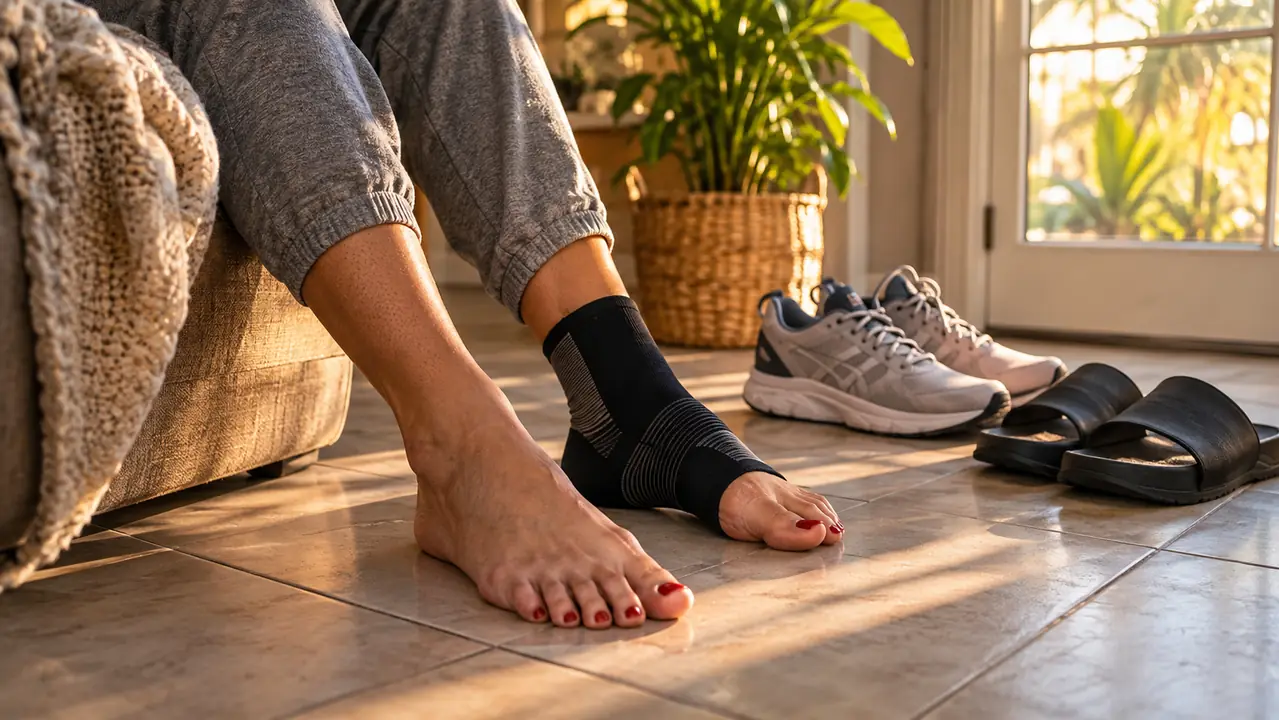
Who Should Buy Which
Buy the BLITZU sleeve if your pain is concentrated at the bottom of the heel and the arch, if your worst ten minutes of the day are the first ten out of bed, and if you need something you can get on without a fight. It suits people who stand for a living, people who just started walking for their health and are paying for it, and anyone who wants to wear their own shoes and their own insoles with a little support added on top. The footless shape also suits anyone whose toes cannot tolerate being wrapped, and anyone with a wide foot or a high instep. Sizing runs up to 2X-Large, and my advice is to read the size chart on the listing and measure rather than guess. I guessed the first time and ended up ordering again.
Look at PAPLUS compression socks instead if the swelling is the bigger problem, if the whole foot and the lower calf ache by evening, or if you are dealing with tired legs as much as a sore heel. They also make more sense for someone whose feet do not swell or ache until the end of the day, since a sock is easier to justify as your regular sock than a sleeve is. If you are buying them for a long flight, a long drive, or a job where you sit for hours at a stretch, that is their territory, not the sleeve's.
If you are on the fence, the tiebreaker for me was the morning. Whatever you buy has to be something you will put on at six in the morning when your heel hurts and you have to be somewhere. Gear that is a nuisance to put on does not get worn, and gear that does not get worn does not help. Everything I own that actually works is something I can put on half asleep in the dark without thinking about it. That is the whole test, and it is a better test than any review, including mine.
If Neither One Is Enough
I want to be careful here, because I am a retired teacher and not a doctor. Compression sleeves and compression socks are comfort measures. They are not a cure, and plantar fasciitis does not resolve because you bought the right accessory. What helped me most in the early months was the physical therapist and the stretches, plus a pair of decent insoles in every shoe I own. On bad weeks I still wear the United Ortho night splint on the right foot. If your pain came on suddenly, if it is severe, or if it has not improved after a few weeks of sensible care, go see your doctor or a podiatrist. That is the advice I would give my own daughter, and it is the advice I will give you.
Start with the one you will actually put on at 6 a.m.
The BLITZU foot compression sleeve is the one that survives a bad morning in my house. Check the size chart before you order, and give it a week of real shifts before you decide.
Amazon See Sizes and Today's Price on Amazon →