
The first four or five steps out of bed are the worst ones of the day. You know the routine. You swing your feet down onto the floor, you put weight on the right heel, and it feels like there is a piece of gravel under the skin that you cannot get at. So you shuffle to the bathroom with your weight rolled onto the outside of the foot, and by the time you have been up ten minutes it has faded to a dull ache that follows you around until lunch. That was my morning for most of 2025, and I got tired of planning my life around it.
I am 64. I taught elementary school for 31 years, retired, and then picked up three mornings a week as a cashier at a garden center on the Florida Gulf Coast. Concrete floor, standing in one spot, eight in the morning until noon. My primary care doctor diagnosed plantar fasciitis in the spring and sent me to a physical therapist for six visits, which is where I learned the stretches I still do. What actually changed my mornings, though, was a pair of PowerStep Pinnacle insoles in my work sneakers combined with a short set of habits I run through before my feet touch the tile. This is the order I do them in, and why.
The pair I keep in my work sneakers, not my good shoes
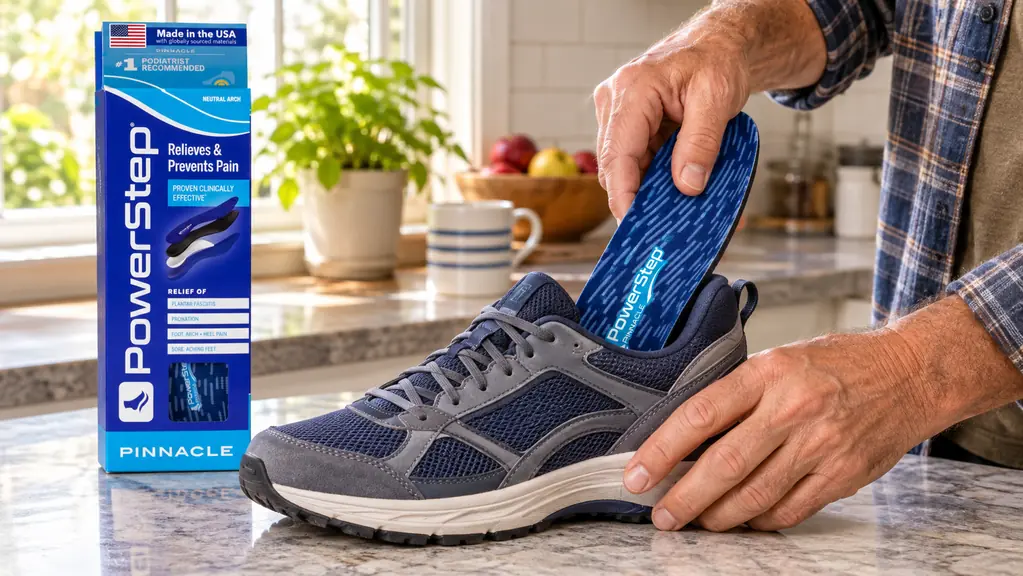
PowerStep Pinnacle is a molded orthotic insole with a semi-rigid polypropylene support shell, heel cushioning, and moderate pronation support. Made in the USA, sold in specific men's and women's size ranges, and backed by a 30-day money-back guarantee. Check the size chart before you order.
Amazon Check Today's Price on Amazon →Why the Morning Is Worse Than the Rest of the Day
The band of tissue that runs along the bottom of your foot, the plantar fascia, tightens while you sleep. Your foot sits pointed for seven or eight hours, the tissue shortens, and then you stand up and ask it to lengthen all at once. That is why the first steps are sharp and the tenth step is not. My physical therapist explained it in about thirty seconds, and it made more sense to me than anything I had read online in a month of looking.
What that means practically is that the morning is the part of the day you can actually do something about. You cannot stretch in your sleep. You can make the surface under your foot kinder, you can loosen the tissue before you stand on it, and you can stop making it worse in the shoes you wear for eight hours a day. The insoles cover the second and third jobs at the same time, which is why they ended up being the piece I would replace last.
Step 1: Put Them in the Shoes You Actually Wear
This is the step most people skip. They buy a good pair of insoles, drop them into the dress shoes they wear twice a month, and then cannot understand why their heel still hurts at work. Mine went straight into the one pair of supportive walking sneakers I wear to the garden center. Those sneakers are on my feet for three shifts a week on concrete, which makes them the highest stakes shoes I own, higher than anything I wear to church.
The Pinnacle is a molded insole built around a semi-rigid polypropylene shell under the arch. Semi-rigid is the word that matters here. It is not a soft gel pad that flattens out under a person of my weight after a week. It holds its shape, and that shape is what gives you support instead of just cushion. The tradeoff is that it takes a few days before your arch stops noticing it.
Take the factory insole out before you put the new one in. I know that sounds like advice for a person who cannot tie her own shoes, but I have watched a friend stack one on top of the other and then complain the shoe was tight. One insole per shoe. Check the size chart on the listing before you order, too, because these come in specific men's and women's ranges and the wrong size will feel wrong no matter how good the shell is.
Step 2: Give Them Two Weeks Before You Judge Them
The first three days, I was aware of my arches every waking minute. Not pain exactly. Pressure, like standing on a low ridge that had been installed under my foot without asking. I took them out on day two and put them back on day three, and Ray told me to give it a full week, which is possibly the only useful thing my husband has ever said about footwear.
By day four the pressure had turned into something I would call support. By day ten I had forgotten they were in there, which is the highest compliment I can pay a piece of molded plastic. If you are still miserable at two weeks, that is information, and it might mean a different insole or a different shoe. PowerStep backs the Pinnacle with a 30-day money-back guarantee, so the clock works in your favor as long as you actually wear them.
One thing I would not do is move them from shoe to shoe all week. The shell adapts to the way you stand, and shuffling it between three pairs every day works against that. Mine live in the work sneakers and come out only to dry. The shoes I wear around the house are a separate conversation, and that is the next step but one.
Step 3: Loosen Up Before Your Feet Hit the Tile
We have tile floors through the whole house. That is normal in Florida and it is unforgiving on a sore heel. I do not walk on it barefoot anymore, not even the four steps to the bathroom at two in the morning. I keep a pair of OOFOS slides beside the bed and I put them on before I stand up, every single time, even when I am half asleep.
The stretch comes first, though. Before I swing my legs off the mattress, I sit on the edge of the bed and loop a towel around the ball of my right foot, then pull gently until I feel it along the arch and up into the calf. Hold it for thirty seconds, three times, then do the other foot out of fairness. It takes two minutes, and on most mornings it is the difference between a sharp stab and a dull ache that lets go by the time the coffee is ready.
My physical therapist gave me that one on the first visit, along with a calf stretch I do standing at the kitchen counter with my heel flat and the ball of my foot up on the bottom step. The towel lives in the bedroom and the calf stretch happens in the kitchen, because a stretch you have to go find is a stretch you will skip. Put the habit where you already stand around waiting for something.
Step 4: Take Care of It After the Shift, Too
Mornings get all the attention because that is when it hurts worst, but the damage gets done during the day. Three hours standing on concrete and the whole arch is complaining by the time I clock out at noon. So my routine has a second half, and the second half happens after work rather than before it, which is also when I am more willing to sit still for a few minutes.
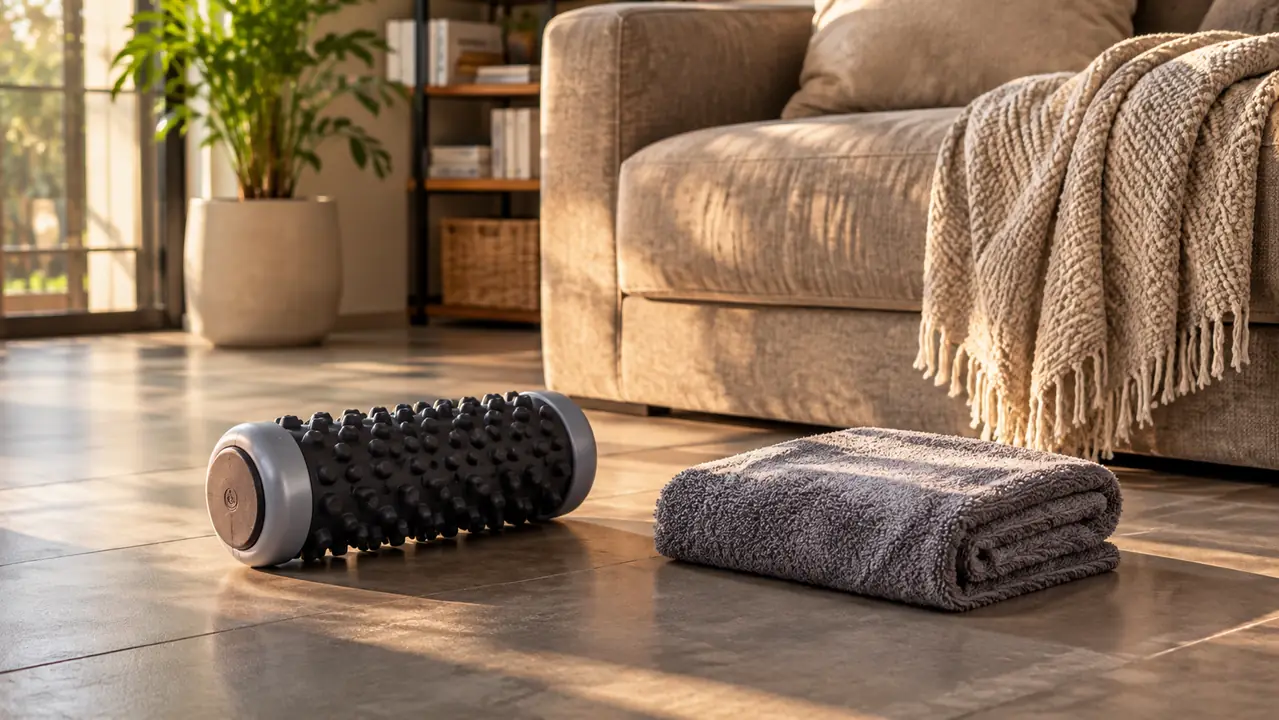
I keep a BESKAR foot roller by the couch. Twenty or thirty slow passes under the arch of the right foot while the evening news is on, with no more pressure than feels like a good stretch. On the long shift days I wear a BLITZU compression sleeve on the right foot, mostly for the swelling that shows up by mid afternoon. Neither one is exciting. Both of them are ten minutes out of my day.
And I replaced my work sneakers. The pair I had been wearing had more than a year on them and the cushioning was flat. You can put a good insole into a dead shoe and get maybe half the benefit you paid for. New sneakers plus the Pinnacle did more than either one alone would have, and I wish I had done the shoe part sooner instead of trying to save a pair that was finished.
Step 5: Have a Plan for the Bad Weeks
I want to be straight with you, because too many people selling foot products are not. This is not a cure. I still have bad weeks. A bad week is when the first steps are sharp again instead of dull, and it usually follows a stretch where I was on my feet more than usual or I skipped the towel stretch because I was busy and thought I could get away with it.
On a bad week I wear the United Ortho night splint on the right foot. It holds the foot at a slight angle overnight so I do not wake up with everything clenched, and it is not comfortable, and I do not love it, and I wear it anyway. I also cut the two mile walk with Ray along the bayfront down to the shorter loop, which he pretends not to mind. He is a retired electrician and he has his own knees to worry about.
And I call the doctor when something changes in a way that frightens me. Sudden severe pain, pain that keeps me awake, numbness in the toes, or a run of weeks where nothing is improving at all. Mine has been a slow grind with good months and bad ones, which I have learned to expect. Anything sudden is a different conversation and belongs with a professional, not with a retired teacher and her kitchen table advice.
The insoles did not make the morning pain disappear. They made the first ten steps shorter, and that changed how the rest of the day went.
What Else Helps
The insoles are the piece I would replace last, but they are not the whole routine. The slides by the bed so a bare foot never touches the tile. The roller by the couch. The night splint on bad weeks. The calf and towel stretches from the physical therapist, which I still do most days and which I expect I will be doing for the rest of my life. And shoes that are actually still shoes and not just the memory of shoes.
Two things that cost nothing. First, if you have a little weight to lose, losing a little of it helps. I am down about twelve pounds since last year, not from any program, just smaller portions, and my mornings got easier in a way I did not expect and cannot fully explain. Second, do not go straight from sitting to walking. Stand up, take a few turns around the kitchen, let everything wake up, then head out.
If you are just starting, begin with the insoles and the morning stretch and give them a month before you add anything else. Change five things at once and you will never know which one did the work. And if your pain is severe, came on suddenly, or has not eased after a few weeks of doing the basics, see a podiatrist. I am a retired teacher with a sore right heel, not a clinician, and what worked for me is not a promise about what will work for you.
Start with the pair that goes in the shoes you wear all day
PowerStep Pinnacle gives you a semi-rigid polypropylene support shell, heel cushioning, and moderate pronation support in a molded insole made in the USA. Backed by a 30-day money-back guarantee. Sizing runs in specific men's and women's ranges, so check the chart.
Amazon Check Today's Price on Amazon →