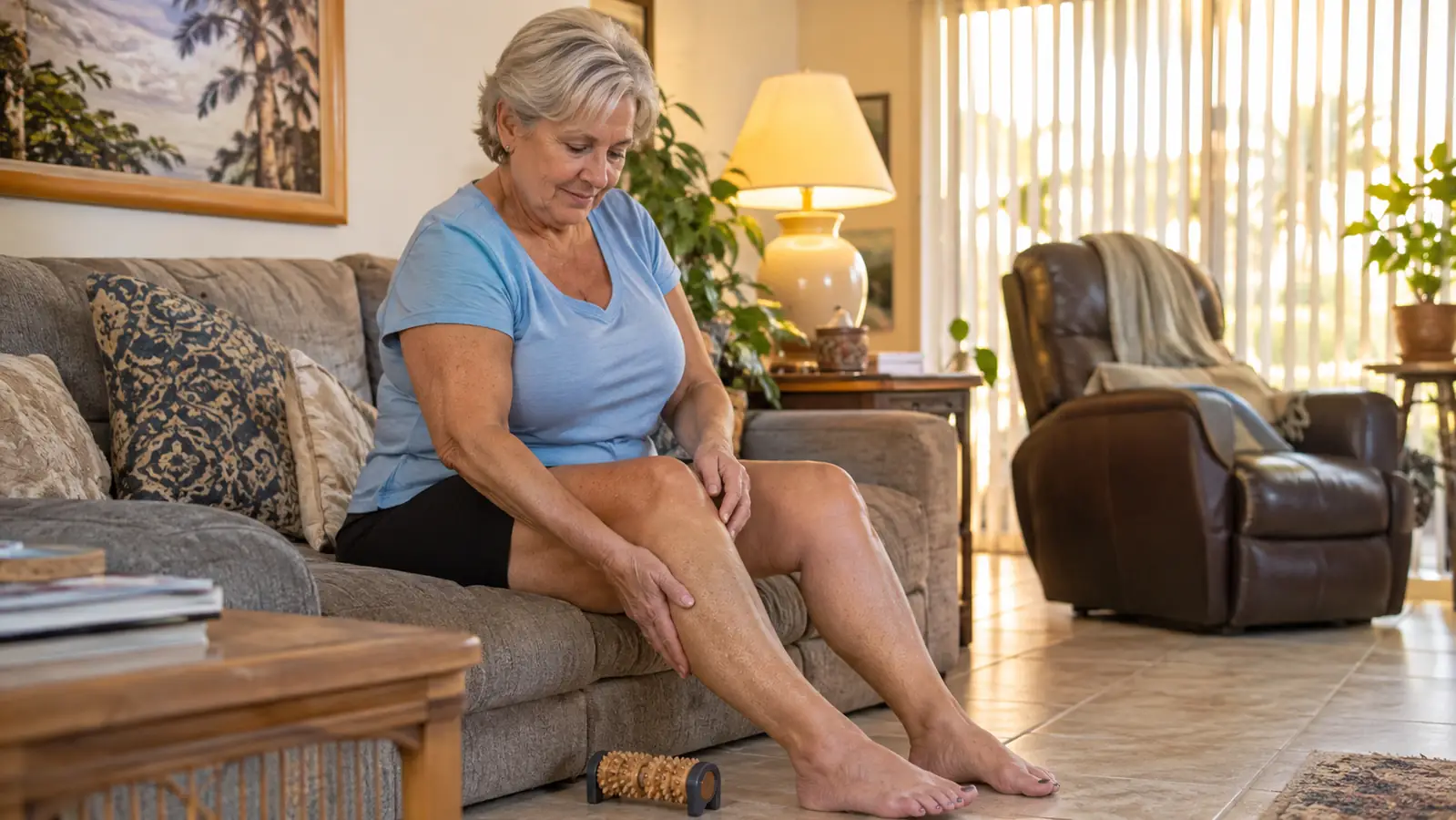
The BESKAR foot roller arrived in a padded envelope, which tells you most of what you need to know about it. It is six inches long, four ounces, and there is nothing electronic inside. No cord, no battery, no heat setting. I bought it myself in July after nine months of a right heel that shouted at me every time my feet hit the tile floor in the morning. I had already been through a frozen water bottle, a lacrosse ball, and a pair of insoles. I was not expecting much.
Here is the honest version, because I have read enough reviews that gush about a four-ounce piece of equipment as if it walked the dog for you. The BESKAR roller did not fix my plantar fasciitis. What it did was give me something useful to do with twenty minutes after supper while Ray watched the ballgame, and that turned out to matter more than I expected. Below is what it is good at, what it is not, the things I wish someone had told me before I ordered, and who I think should keep their money.
The Quick Verdict
A small manual roller that earns its place beside the couch. It softens the morning ache. It will not replace stretching, insoles, or a podiatrist.
Amazon Check Today's Price →Twenty minutes a night, no cord, nothing to charge
This is the roller I keep by the couch and use while the news is on. Six inches, four ounces, and the pressure is whatever I lean into it.
Amazon Check Today's Price on Amazon →How It Ended Up Next to My Couch
I taught elementary school for thirty-one years, and I retired thinking my feet had gotten away with something. Then I took a three-morning-a-week job as a cashier at a garden center, standing from eight to noon on the polished concrete that runs the length of the whole store, and by February of 2025 my right heel had opinions. It was worst on the first steps out of bed, and again after I sat through lunch. My doctor diagnosed plantar fasciitis in the spring and sent me to a physical therapist for six visits. I still do the calf stretches and the towel scrunches she taught me. I am not cured. I have good weeks and bad weeks, and most mornings now the first steps are a dull ache that loosens in a few minutes rather than the stab it used to be.
Along the way I tried the cheap stuff. I started with a frozen water bottle in March, rolling it under my arch for ten minutes after supper, and it worked well enough that I kept at it for a month. But the bottle sweated a ring into the rug, and Ray got tired of stepping in it. The lacrosse ball came next. It is hard as a doorknob and it does get in deep, but mine kept skittering under the coffee table where Biscuit, my orange tabby, treated it as a new toy, and I got tired of crawling after it with a sore heel. A tennis ball was too soft to do anything at all. What I wanted was something I could keep beside the couch, put my foot on without hunting for it, and press into without feeling like I was bruising myself. That is a small and unglamorous list of wants, and the BESKAR roller met it.
What It Actually Is, and What It Is Not
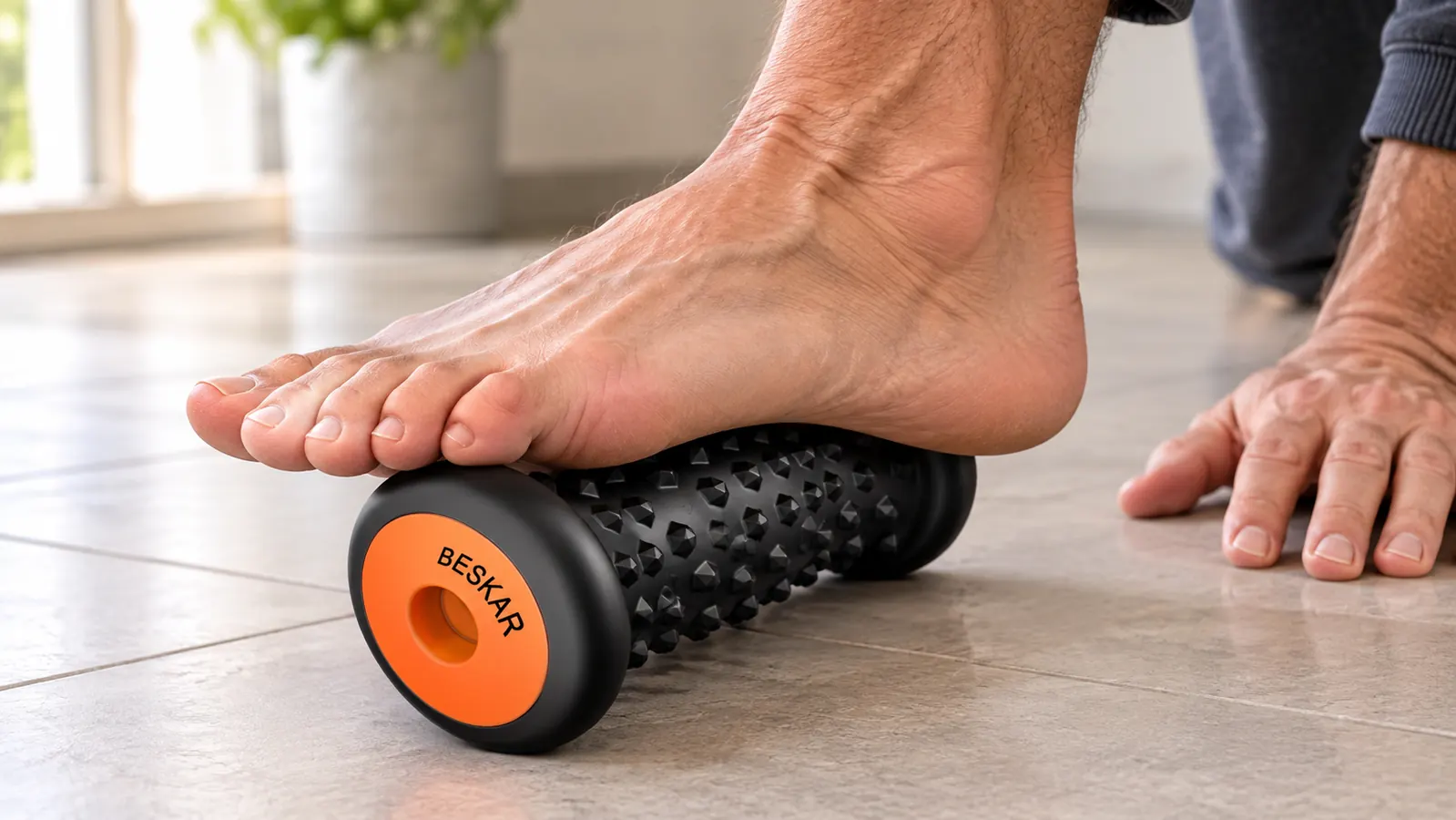
The listing calls it a portable reflexology foot massage roller, and that is accurate as far as it goes. The BESKAR roller is manual. There is no power source, no vibration, no heat. The massage technique is rolling, which sounds obvious until you realize how many gadgets out there are trying to do something fancier. The product grade is home use, it targets the foot, and it is not water resistant. Six inches long, 2.59 inches across, four ounces. I set it against a ruler on the kitchen counter the day it arrived, mostly to see whether it would fit in the side pocket of my tote bag. It does, with room left over for my keys. That is more than I can say for the night splint, which has to be carried like a small suitcase.
Because it is longer than it is wide, it rolls in a line under your foot instead of skittering off sideways the way a ball does. That single difference is why it stayed by the couch and the lacrosse ball went into a drawer. The listing describes the surface as deep-tissue acupressure and says the shape is designed to fit the natural curvature of the arch. In plain terms, you put your foot on it and roll from the ball of your foot back to the heel, and the pressure goes wherever you lean. You are the engine. Lean hard and it is a firm massage. Barely rest your foot on it and it is a gentle one. That control is the whole point, and it is also the whole problem, which I will get to. The width is what makes the difference. A ball gives you one point of contact that wanders. This gives you a line, and the line stays where you put it.
The way I use it is simple. I sit on the couch with my right foot on the roller and roll from the ball of the foot back to the heel, slowly, for about three minutes. Then I turn it slightly and work the arch from the inside edge to the outside. Then I switch feet. I have never once timed it, so my three minutes are probably closer to five, which is fine. It is not a workout and it is not uncomfortable, unless I lean too hard, and then it is exactly as uncomfortable as I asked for. Ray tried it once and said it felt like standing on a rolling pin, which is a fair description if you do not have a sore arch. If you do have a sore arch, it feels like something is finally pressing in the right place.
Twenty minutes with the roller bought me a morning where the first four steps were a dull ache instead of a stab. That is not a cure. It is a trade I would make again.
What Nobody Tells You Before You Buy
The first week hurts. Not hurt-you hurt, but the arch of my right foot was tender the morning after my first serious session, and I briefly convinced myself I had made things worse. That was a Tuesday, and I spent the rest of the day noticing every single step I took across the tile. What I had actually done was work tissue that had not been worked in a while. I backed off to a few minutes a side and built back up over about ten days. If you start by bearing down with your full weight for twenty minutes because a video told you to, you will be sore and you will blame the roller.
It is not water resistant. I know that sounds like a small thing. It is not, if your habit is to roll your feet in a hot shower, which is where a lot of people do their best thinking. This one stays dry. The first week I had it I carried it into the bathroom out of habit, looked at it, and carried it right back out, because the listing was plain about the water and I did not want to find out the hard way what a soaking would do. I keep a damp cloth nearby and wipe it down, and I do not leave it out on the lanai where the afternoon rain can find it. Four ounces of manual equipment is not built to sit in water, and the listing does not pretend otherwise.
It does nothing for your calf, and your calf is very likely part of the problem. The physical therapist was blunt with me about this. Tight calf muscles pull on everything downstream, and no roller under your arch will undo that. The towel stretches and the wall stretches did more for my mornings than any gadget, and I would be lying if I said otherwise. The roller is a comfort and a habit. It is not the load-bearing beam.
And it will not stay where you put it if you have a cat. Biscuit has knocked it off the couch twice. It survived both times, because there is nothing in it to break, but if you are the sort of person who needs equipment to be treated with respect, this is not that.
What I Liked
- Small enough to live beside the couch, so I actually use it
- Manual, so I set the pressure with my own body weight
- Rolls in a line under the foot instead of shooting off sideways like a ball
- Nothing to charge and nothing to break, and it works on both feet
- Four ounces, so it goes in a tote bag for a shift
Where It Falls Short
- Not water resistant, so no rolling in the shower
- Does nothing for tight calf muscles, which is usually the root of it
- The first week is tender if you push too hard too soon
- Six inches is a small surface if you have big feet
- It is a comfort tool, not a treatment
What Six Weeks of Daily Use Did
I have used the BESKAR roller most evenings since mid-July, five to ten minutes per foot while the news is on. The left foot does not really need it, but I do it anyway because it feels good and because uneven feet seem like a bad idea at my age. Week one was tender. Weeks two and three were where I noticed a change, not because the pain vanished but because the mornings got shorter. Instead of four or five steps of sharp pain, I got two or three steps of ache. Week three was the real test. I worked three shifts in a row and did the bayfront walk with Ray on two of those evenings, and Thursday morning I fully expected the old stab back. It was a dull ache, and it was gone by the time I had the coffee going.
By week five I was getting out of bed without bracing a hand on the nightstand, which is a small dignity I had missed more than I expected. I want to be careful here, because this is exactly the point where a review starts overselling. My mornings are better than they were in the spring. They are not gone. I still have bad weeks, usually when I have worked three shifts in a row or walked the bayfront path in thin shoes. On those weeks the night splint comes back out and the roller is a comfort rather than a fix. What I can say is that the roller is now part of a routine that works: insoles in the work sneakers, slides on the tile at home so I am never barefoot, the calf stretches from the therapist, and ten minutes with this thing before bed. Take any one of those away and I could not tell you which one is doing the heavy lifting.
What I Would Change
If I could change one thing, it would be the firmness. The roller has one setting, which is whatever your body weight makes it, and on my bad weeks I want something softer and on my good weeks I want more bite. My workaround is a folded hand towel tucked under one end, which is not elegant and does not fool anyone, but it does the job. The other thing I would change is the guidance. I would have liked the listing to say plainly: start with a few minutes a foot and build up. I learned that the sore way, and there is no reason for the next person to.
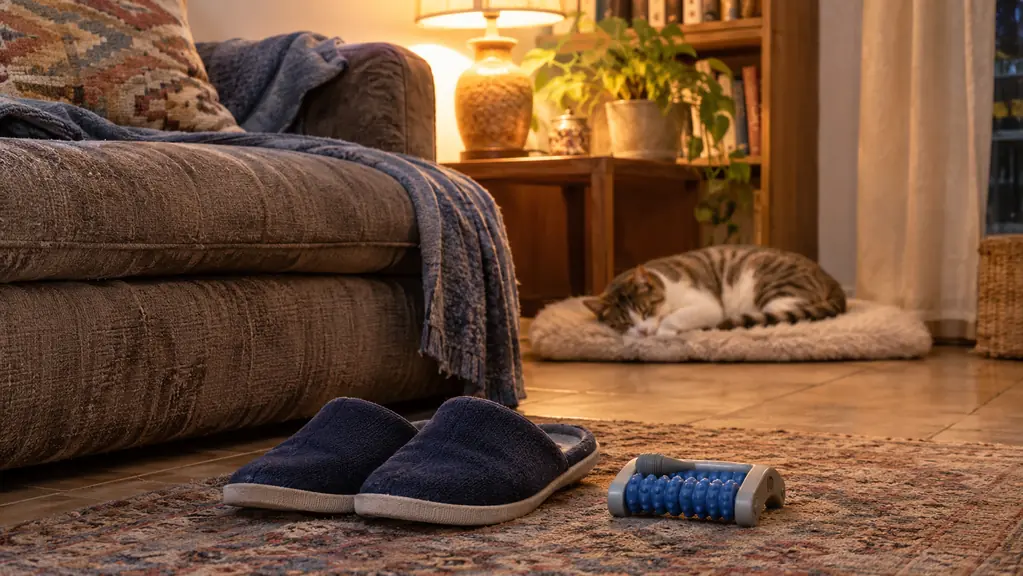
I would also tell you to keep it where you sit, not where you store things. The reason this roller has worked for me and the lacrosse ball did not is not that it is a better piece of equipment. It is that the roller lives beside the couch where my hand falls on it, and the ball lived in a drawer. There is a small basket next to the end table that holds the roller, the television remote, and my reading glasses, and that basket is the entire system. If you buy this and put it in a closet with the resistance bands and the foot bath you used twice, it will do nothing for you. That is not the roller's fault, but it is the honest reason most of these purchases fail.
Who This Is For
If your heel hurts worst on the first steps out of bed and eases as you move around, and if you are the sort of person who will actually sit down for ten minutes in the evening, this is a reasonable thing to own. It suits people who want to control the pressure themselves, who have tile or hardwood floors and no interest in walking on them barefoot, and who like the idea of a tool that lives where they sit rather than in a drawer. It also suits anyone who has tried a lacrosse ball and found it too hard, or a tennis ball and found it too soft, and wants something in between that stays put. Mostly it suits the person who has already seen a doctor and been told the ordinary things: stretch, wear better shoes, do not go barefoot on hard floors. This is a small addition to that list, not a replacement for it.
Who Should Skip It
Skip it if you are looking for something that does the work for you. There is no motor here. Skip it if you want heat or vibration, because there is none of either. Skip it if you plan to use it in the shower, because it is not water resistant and I would not test that. Skip it if your pain is severe, sudden, or getting worse, or if you have numbness or tingling in the foot, or if a heel woke you up at night. That is a conversation with a doctor or a podiatrist, not a purchase. And skip it if you know in your heart that a four-ounce roller will end up in the closet by October, because the roller only helps the people who use it. The equipment was never the hard part. The ten minutes were.
If the first steps out of bed are the worst part of your day
It is four ounces, it needs no charging, and it lives beside the couch. That is the whole pitch, and for me it was enough.
Amazon Check Today's Price on Amazon →