If your first four steps out of bed feel like walking on a bruise, someone has already told you to roll your foot on something. A frozen water bottle. A tennis ball. A lacrosse ball, because a stranger in a comment section swore it fixed him for good. I worked through all of those before I bought the BESKAR foot roller, and I have now used both on the same right heel through a long hot Florida summer of garden center shifts. Here is the short answer first, then the details.
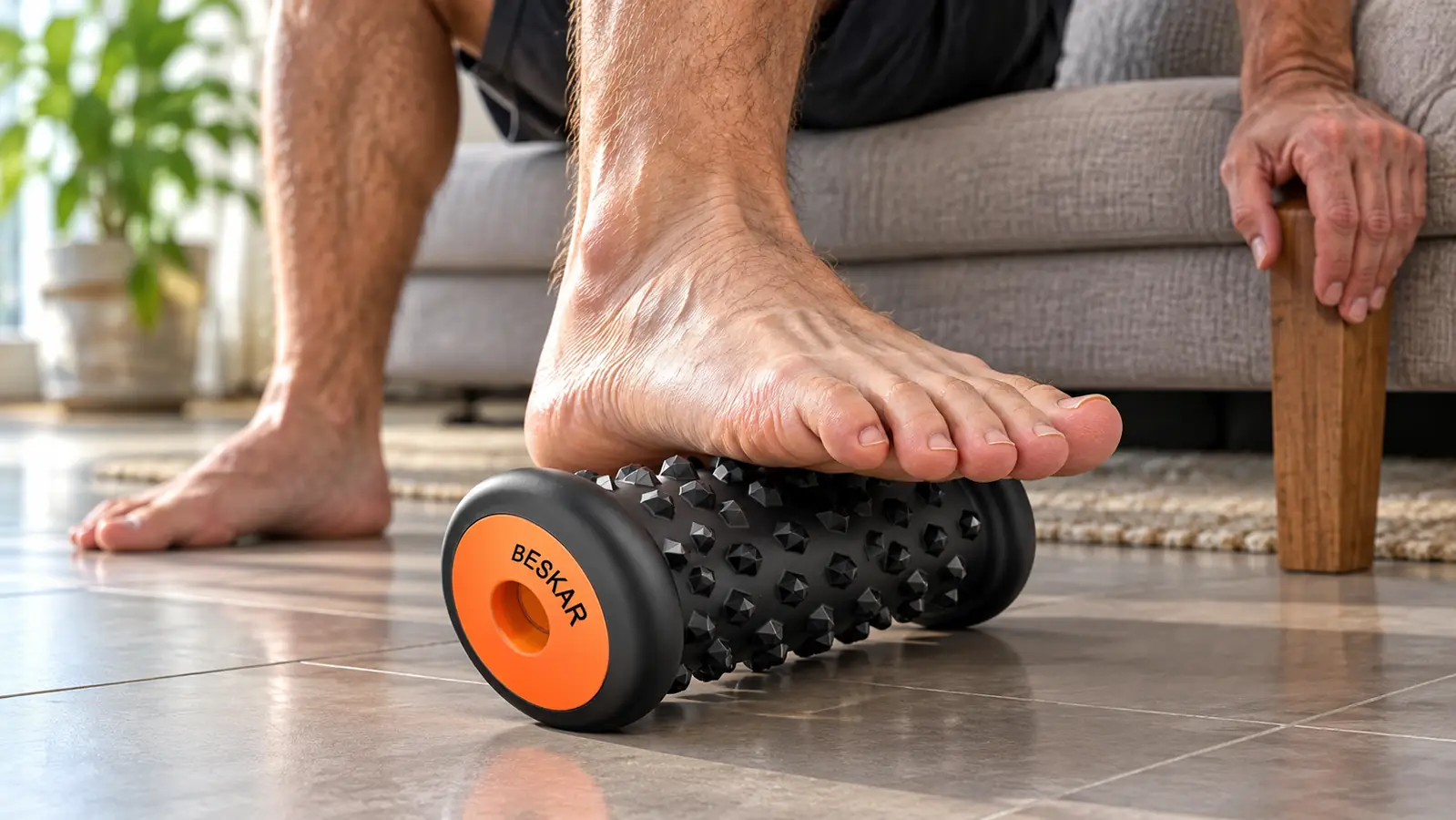
They are not the same tool and they are not really competing for the same job. A lacrosse ball is a hard, round pressure point. It goes exactly where you put it, it never softens, and it hurts in a way that is either useful or too much depending on the morning. The BESKAR roller is six inches long, weighs four ounces, and is shaped to sit under the arch of a foot, so it works along the whole underside in one pass instead of one small spot. For the tight morning heel, the roller is what I reach for. For a single stubborn knot I want to dig at, the ball still wins. Most people with plantar fasciitis need the first job handled far more often than the second.
| BESKAR Foot Roller | Lacrosse Ball | |
|---|---|---|
| Under the arch | Shaped to follow the natural curve of the arch, so it meets the whole underside at once | Round, so it touches one small patch of skin at a time |
| Pressure | As much as your body weight gives it, spread along the arch | As deep as you can stand it, concentrated on one point |
| Staying put on tile | Six inches long and four ounces, it sits where you set it down | Rolls in every direction and will find the far side of the room |
| Working one sore spot | The shape invites a rolling pass rather than a long hold | You can park on one spot and stay there as long as you like |
| Standing at a counter | Stays under the foot while you shift your weight | Escapes sideways the moment you lean |
| Toting it around | Portable at four ounces, but it takes up real room in a bag | Fits in a jacket pocket and goes anywhere |
| Cleaning it | Listed as not water resistant, so it gets wiped and dried | Rinse it under a tap and let it air dry |
| Best for | Morning tightness and long shifts on concrete | One deep knot you want to work hard |
Where the BESKAR Roller Wins
The roller's entire argument is its shape. Mine measures six inches long and a little over two and a half inches across, and the curve is built to follow the underside of a foot rather than fight it. That sounds like a line from a listing until you are standing on cold tile at six in the morning with a heel that will not take weight. A round ball makes contact with one small patch of skin, and your foot has to balance on top of it while you hunt for the sore part. The roller meets the arch along its length. I put my foot down, rock from heel to toe, and the whole band gets worked in a single pass instead of four separate pokes.
The second thing, and the one I did not expect to care about, is that it stays where I put it. Four ounces, six inches long, sitting flat on the floor. When I shift my weight to reach the coffee maker, it is still there. My lacrosse ball has been under the refrigerator twice and behind the cat's water bowl once. When your heel is buzzing after three hours on concrete, crawling across the kitchen after your own tool is a small added insult you do not need. The roller sits, I roll, and I am finished in three or four minutes. Rated 4.6 by more than six thousand buyers, and after a summer of it, I understand why the rating holds up.
But the real reason the roller wins for me has nothing to do with specifications. The best tool is the one you actually pick up on a tired Tuesday when you are running late and your heel is complaining. I kept the roller by the couch and I use it most evenings during the news. I kept the ball in a drawer and I use it on bad weeks. That is not a knock on the ball. It is just what happens when one tool asks you to sit down and the other asks you to stand on a rock.
Where a Lacrosse Ball Wins
Now the honest part, because a comparison where one side wins everything is not a comparison. A lacrosse ball is harder than anything sold for feet, and it is round in every direction, which means you can put your full weight on it and get pressure the roller will never give you. On a bad week, when the fascia under my right heel feels like a rope pulled tight, the ball gets in deeper than rolling does. If you have been at this for months and the tightness sits in one stubborn place, a ball will find it. It will also make you say words you would not use at the garden center.
The ball also lets you stop. The roller's shape invites movement, which is usually what you want in the morning, but sometimes you want to put one spot under pressure, hold it for thirty seconds, breathe, and come off. A ball does that better than a roller can. It also rinses clean under a tap in about four seconds, and the BESKAR roller is listed as not water resistant, so mine gets wiped with a damp cloth and dried instead. And most people do not have to go buy a lacrosse ball. There is one in a garage or a gym bag or a bin at a sporting goods store, and it will outlast your car.
The one that stays by the couch instead of in a drawer
Six inches long, four ounces, shaped to the arch. This is the tool I use on an ordinary Tuesday, not just on a bad week.
Amazon See the BESKAR Roller on Amazon →Four ounces, six inches long, and it still sits exactly where I put it at six in the morning. That is the whole reason the roller lives by the couch and the ball lives in a drawer.
How I Actually Use Each One
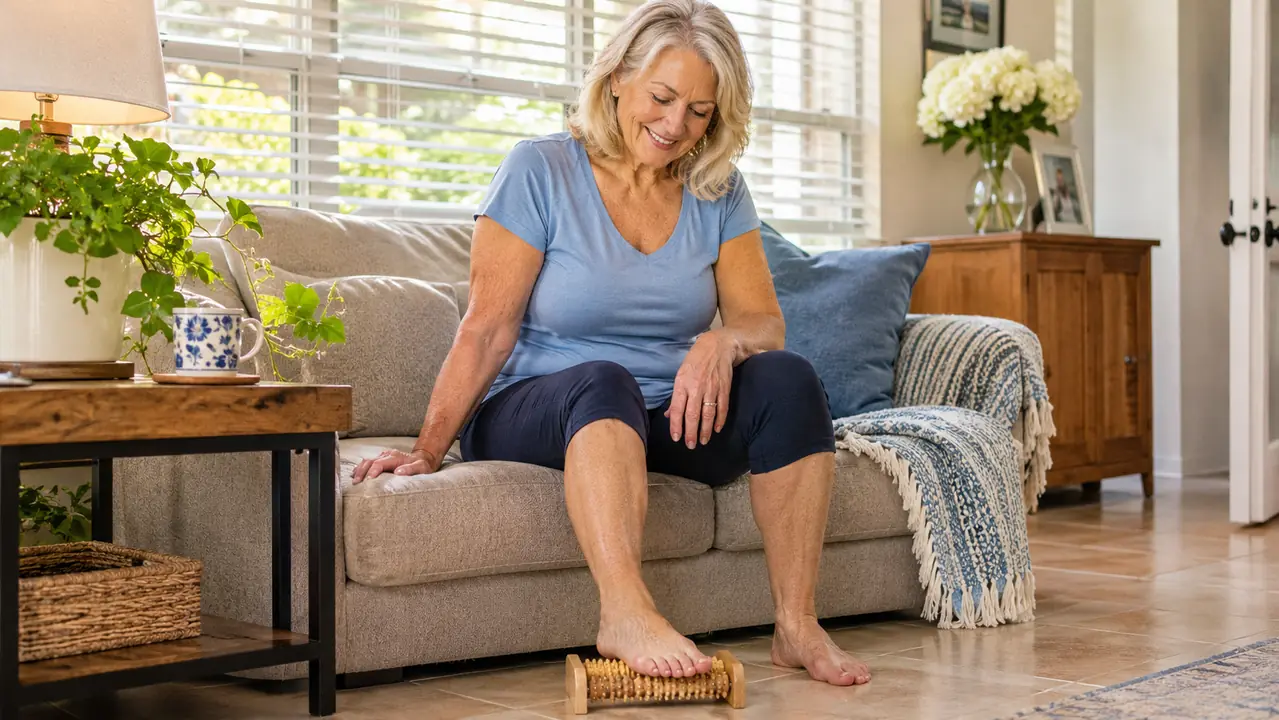
My routine is not complicated and I am not going to dress it up. Out of bed, hand on the dresser, thirty seconds of the calf stretch the physical therapist taught me. Then I sit on the edge of the couch and roll the right foot for three or four minutes while I wake up. That is the roller's job and it does it before I have made coffee. By the time I am standing at the counter with a cup, the sharp part of the morning has usually faded to a dull ache that loosens as I move around the house.
Evening is different. After a shift, or after Ray and I walk the bayfront path, the whole underside of the foot is tired rather than tight. That is roller work again, longer this time, five or six minutes while the news is on. The ball comes out when I can feel one specific spot under the heel that will not let go. I set it on the tile, stand on it with maybe half my weight, and hold. Thirty seconds, breathe, come off. Twice on each side of the sore spot. Then the roller to finish, because finishing with the ball leaves the foot feeling bruised.
I want to be clear about something the internet is not clear about. Standing on a lacrosse ball at sixty-four, on a tile floor, first thing in the morning, is a balance exercise I did not sign up for. I hold the counter when I do it. If your balance is not what it was, or if you bruise easily and a bruised arch is a bigger deal for you than it used to be, the ball deserves more respect than it gets in most of those videos. The roller does not require you to stand on anything. You sit, you roll, you get up.
One more practical note. When I first started, I overdid it on both tools. Ten minutes with the ball on a Saturday morning left me limping worse on Sunday, which is not the direction anyone wants. Three to five minutes, once or twice a day, is what actually helped. The roller makes that easy because it is already beside the couch and there is no setup. The ball makes it easy to overdo because it feels like progress while it is happening.
The Tile Floor Problem Nobody Mentions
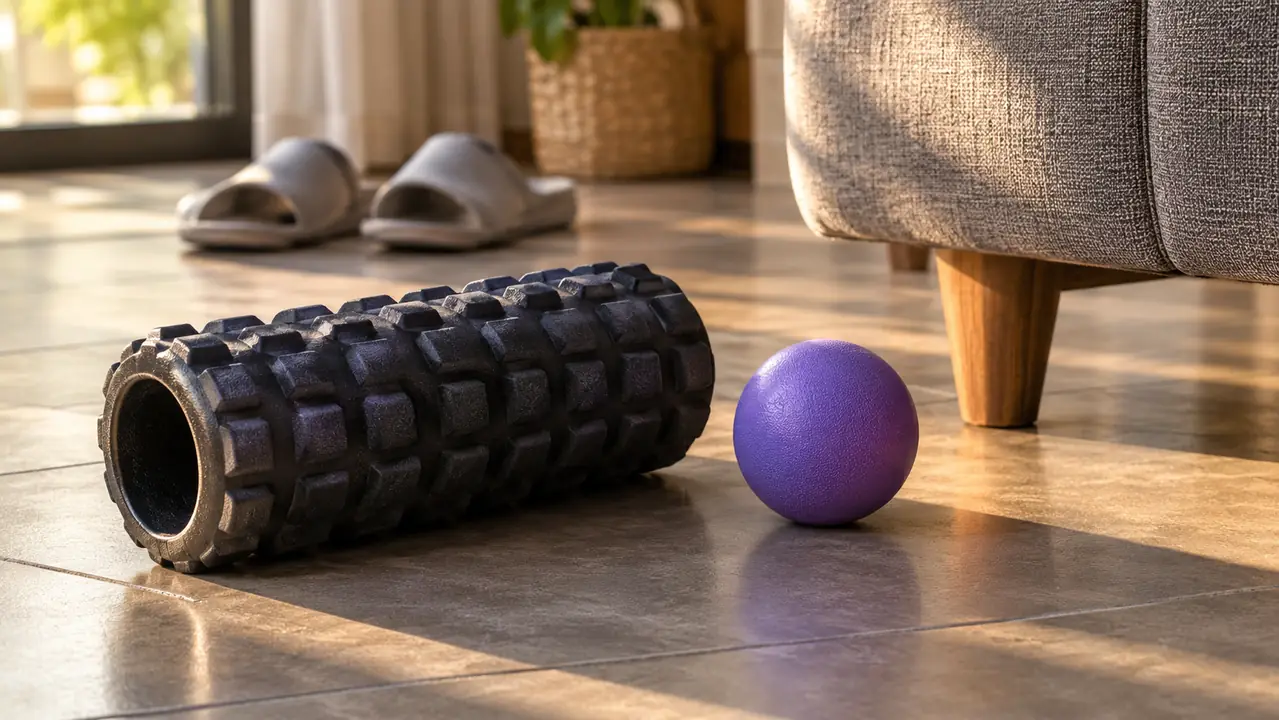
Here on the Gulf Coast, nearly every room in my house is tile. I have not gone barefoot at home in a year, and I mean that literally. Tile has no give. Whatever you put under your foot on tile feels harder than it would on carpet, and a lacrosse ball on tile is a different experience from a lacrosse ball on a rug. It also travels. Round object, hard flat floor, nothing much in the way of friction. I have chased mine across the kitchen more than once, usually while muttering.
The roller behaves better on tile, which is most of why it ended up beside the couch instead of in the drawer. It sits flat and stays. Biscuit, who is an orange tabby with strong opinions about anything on the floor, has knocked it off the couch twice and it has survived both. I wipe it down once a week with a damp cloth, dry it, and set it back. There is no routine to maintain and nothing to plug in, because it is a manual tool that does exactly what your own body weight tells it to do.
What Neither Tool Will Do
Neither one is going to fix the reason your heel hurts. Rolling feels good because it moves fluid around and loosens tissue for a while, and the BESKAR listing talks about circulation and acupressure, which matches how it feels underfoot. But it does not change how you stand, how tight your calves are, or how many hours you spend on concrete. If I roll for four minutes and then stand on a hard floor for six hours in flat shoes, I have wasted my four minutes. The tool is not the plan. The tool is a small part of the plan.
What changed my mornings was the boring stuff. Supportive walking sneakers for the garden center, not the pretty ones. PowerStep Pinnacle insoles inside those sneakers. The United Ortho night splint on the right foot on bad weeks, which is not comfortable and which I wear anyway. OOFOS slides as house shoes so the tile does not get a vote. The BLITZU compression sleeve on long shift days. The roller is one piece of a routine that took me most of a year to build, and I would be lying if I told you it was the biggest piece.
And here is the part I will say out loud every single time. If the pain is severe, if it came on suddenly, if there is numbness or tingling, or if you have been at this for weeks and nothing is improving, go see a doctor or a podiatrist. Mine diagnosed plantar fasciitis in spring of last year and sent me to physical therapy for six visits, and the stretches I learned there did more for me than any tool on this page. A roller is a good habit. It is not a diagnosis, and it is not a cure.
Who Should Buy Which
Buy the BESKAR roller if your pattern looks like mine. Tight and sore in the morning, worse after sitting through a long lunch, a dull ache that loosens as you move, and a job or a walking habit that puts you on hard floors all day. Buy it if you want something you can use sitting down, half awake, without holding onto a counter for balance. Buy it if you already know in your heart that you will not stand on a ball for thirty seconds a side every morning, because the tool you actually use will always beat the tool that is theoretically better.
Buy the lacrosse ball instead if you are further along, if the tightness is stubborn and specific, if you want to work one spot hard, and if your balance is good enough to stand on a round object safely. If you are going to do both, do both. The ball is probably already in your garage and it costs you nothing but a little gritting of teeth. The roller is the one that ends up living where you sit, and on the ordinary days, that is the one that gets used.
Start with the one you will actually pick up
Six inches long, four ounces, and it lives by the couch instead of in a drawer. That is the entire reason mine gets used most evenings.
Amazon Check Today's Price on Amazon →