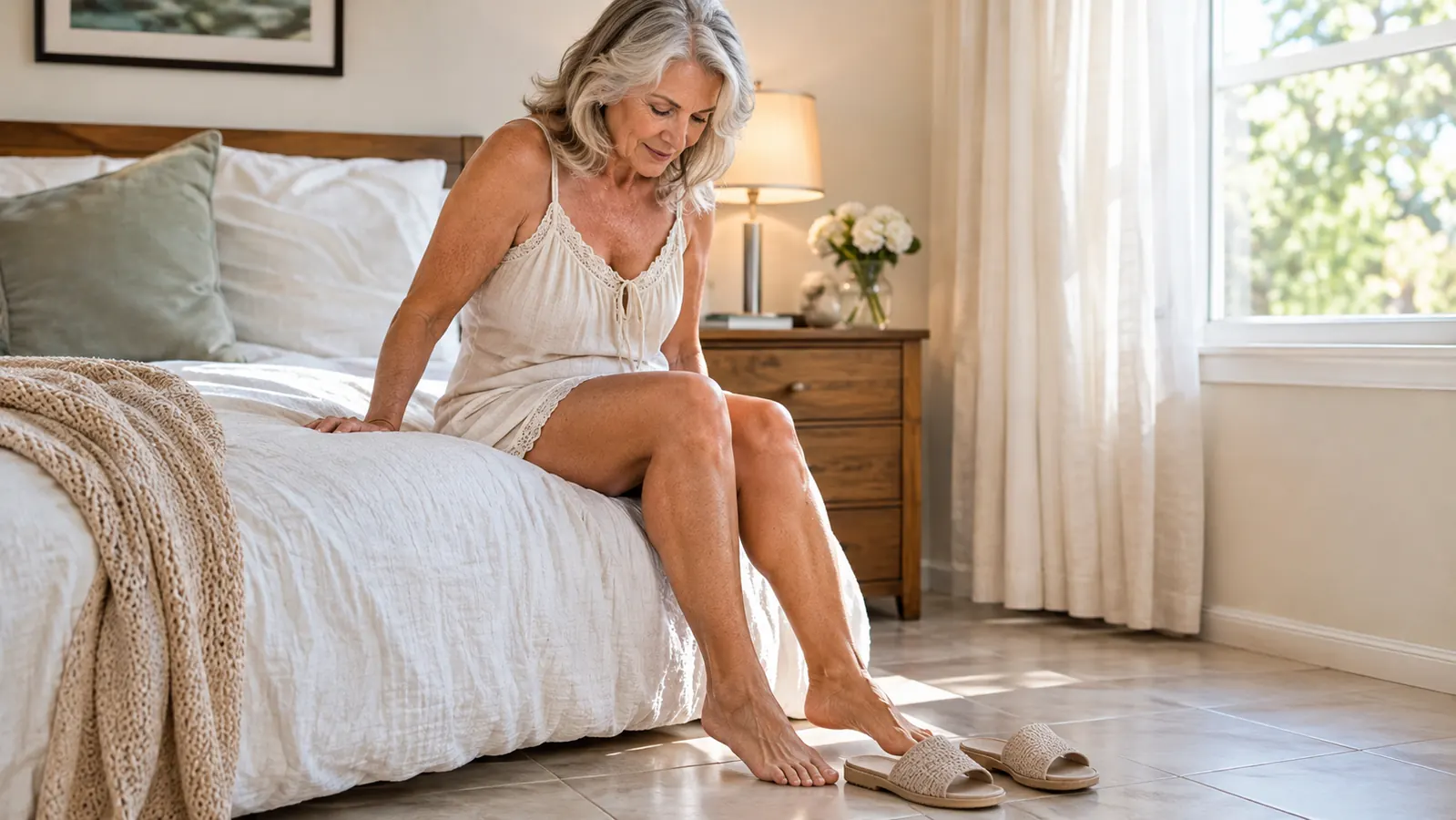
Tile floors are everywhere in Florida, and for most of my life I counted that as a good thing. Cool underfoot in July. Easy to mop. Nothing to trap sand. Then my right heel started in on me in the spring of 2025, a few weeks after I took a part time job as a cashier at a garden center, and the floor of my own house quietly turned into the enemy.
The pattern was consistent enough to be funny. Eight hours on concrete at the register, then a decent evening on the couch with Biscuit on my lap. Then I would get up in the morning, put a bare foot down on cold tile, and take that first step like I was stepping on a tack. Ten feet to the bathroom felt like a quarter mile. My doctor diagnosed plantar fasciitis that spring and sent me to a physical therapist for six visits, and the therapist told me something I have repeated to half the people at work since: the first five minutes of your day matter more than the other twenty three hours. The thing that finally broke the cycle was a pair of OOFOS OOahh recovery slides that now live by my bedroom door and never go outside.
Here is why that matters more than it sounds. The shoes that help you at work can be completely undone by twenty minutes of padding around your kitchen barefoot. My work sneakers have PowerStep Pinnacle insoles in them and they do their job. But tile has no give at all, and a bare heel on tile takes the full load of every step with nothing whatsoever to soften the landing. So the fix was not a better work shoe. It was a house shoe. What follows is the routine I built around mine, in the order I would give it to a friend who called me from the shoe aisle.
The pair that lives by my bedroom door
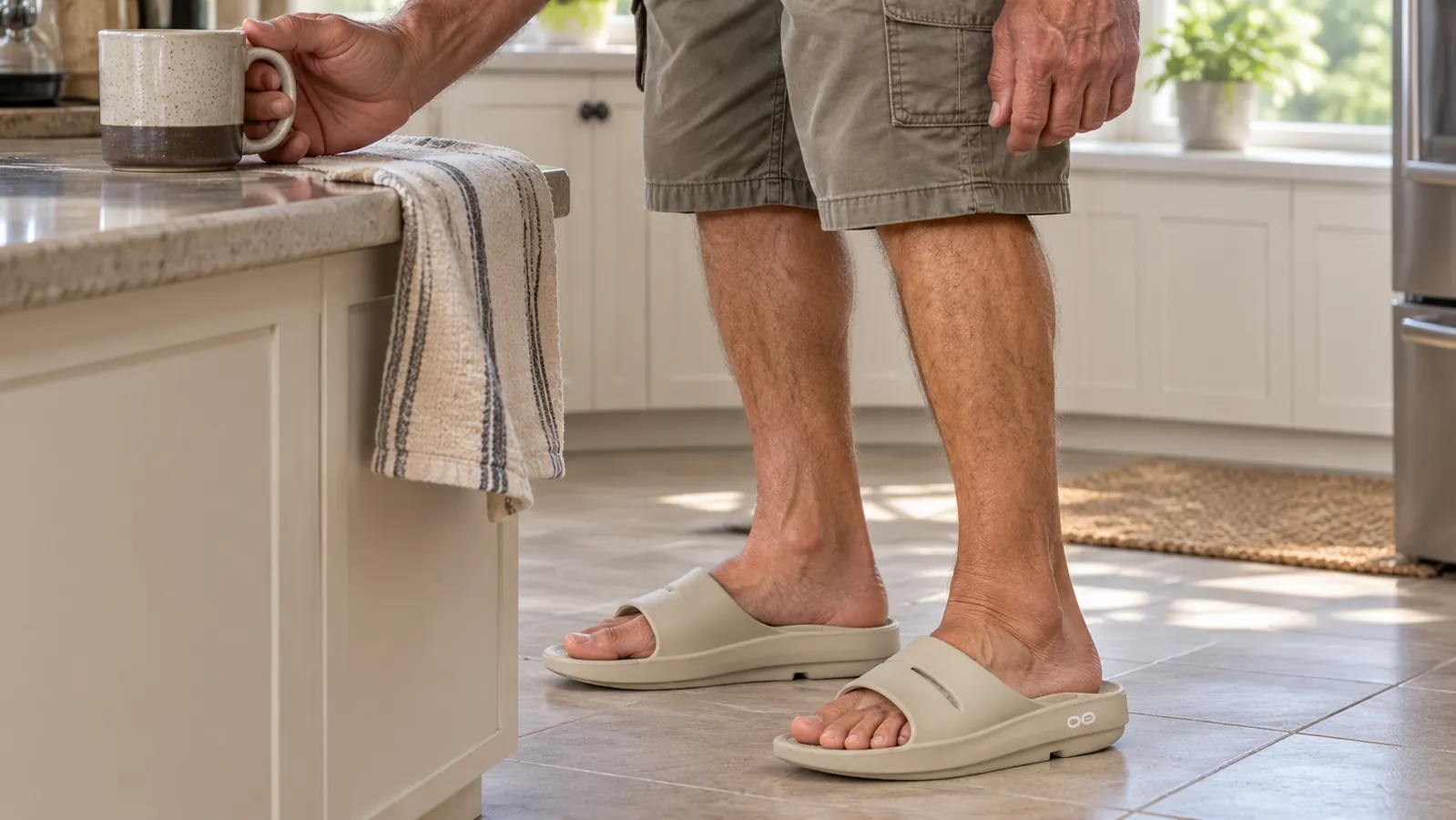
The OOFOS OOahh is a slip on recovery slide with a foam footbed and real arch support. 13.12 ounces, waterproof, single strap, open toe. It is the only thing I wear on the tile at home.
Amazon Check Today's Price on Amazon →Step 1: Get Your Bare Feet Off the Tile Before Anything Else
Before you buy a single thing, change one habit, and change it tonight. Do not let a bare foot touch the floor as your first act of the day. Not to go to the bathroom, not to let the cat in, not to start the coffee. The tissue under your heel has been cool and shortened all night, and the first load you put on it is the load it remembers for the rest of the morning.
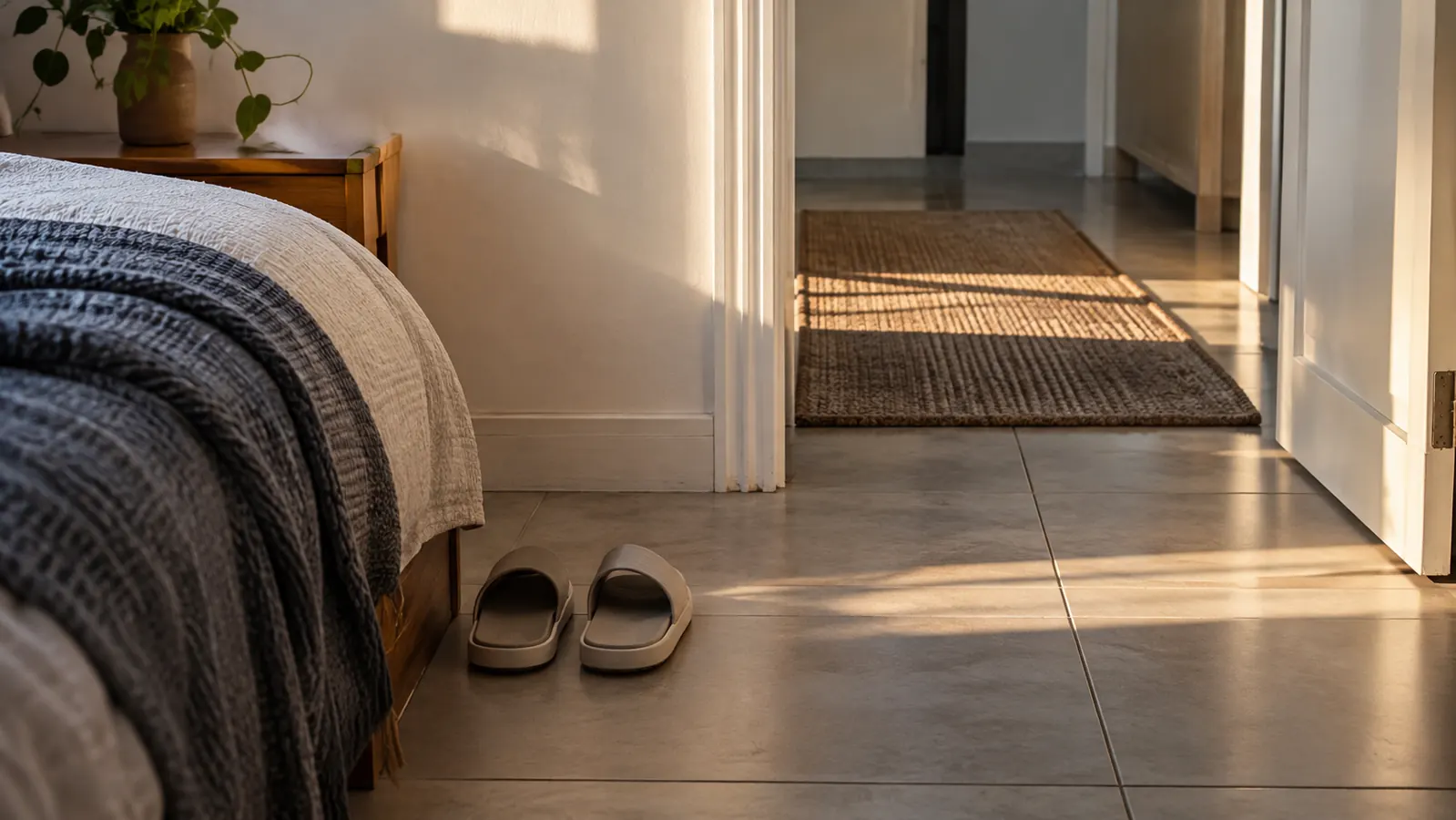
I keep my slides at the side of the bed with the toes pointing out, so my feet land inside them instead of on the tile. It sounds too simple to be worth writing down. It mattered more to my mornings than the night splint did, and I say that as someone who wore the splint faithfully for a couple of months.
If the bed is not where your trouble is, find where it actually is. For my husband Ray it would be the garage. For me it was the ten feet between the bed and the bathroom, plus the long stretch of kitchen tile where I stand to make breakfast. Cover both ends of that trip. A cheap runner rug helps, and I have one, but a rug does not hold up your arch. It just makes the landing a little softer. Soft is not the same as supported, and that took me an embarrassing amount of time to understand.
Step 2: Choose a House Shoe With Arch Support, Not a Squishy Slipper
This is where most people go wrong, myself included. My first attempt was a pair of foam slippers off a grocery store shelf. They felt wonderful for about two weeks. Then the foam packed down flat and I was essentially walking around in socks. A hurting heel does not need soft. It needs to be held up.
What I look for now in a house shoe: a footbed with an actual arch under it, foam that springs back instead of staying dented, a strap or a rim that keeps the foot from sliding, and a sole that will not skid on a wet kitchen floor. The OOFOS OOahh slide hits all four. It is a slip on with a single strap across the top, an open toe, a foam footbed, and a synthetic rubber outer sole that is waterproof, which matters in a house where the dishwasher has leaked twice. The whole thing weighs 13.12 ounces.
The weight is not a small detail. A recovery shoe that feels heavy is a recovery shoe you kick off under the desk without thinking. At 13.12 ounces mine feel like nothing, so I forget I have them on, which is the entire point of a house shoe. There is also no heel cup to speak of, so nothing presses on the exact spot that hurts. It is a slide in the literal sense: your foot sits on top of the foam and a single strap holds it there. The reviews are consistent that sizing runs true, and mine did too.
Step 3: Set House Rules So They Actually Stay on Your Feet
A house shoe only works if it is on your foot. That sounds obvious until you notice how often you take four barefoot steps to grab a towel. So I made rules, and Ray will tell you I am not normally a rules person.
The rules: the slides live at the bedroom door and go on before I stand up. They do not go outside, not even to the mailbox, because a pair that goes outdoors picks up grit in the footbed and then carries it back across the house. Socks are optional in July and non negotiable in January, when the tile gets cold enough to wake up my whole foot. There is a mat at the kitchen sink and a second one at the stove, because those are the two places I stand still the longest without moving.
If your house has two floors or two bathrooms, get the second pair before you need it. Half of the reason this stuck for me is that there was never a morning where I was tempted to go barefoot because the shoes were in the other room. One pair by the bed covers a one story Florida ranch. If my kitchen had been upstairs, I would own two.
Step 4: Warm the Calf Before You Take the First Step
The slides deal with the floor. They do not deal with a tight calf, and a tight calf is what pulls on the fascia in the first place. My physical therapist gave me two stretches and I still do both, more than a year later.
The first one happens in bed, before my feet touch anything. I loop a towel around the ball of my right foot, hold both ends, and pull the toes toward me until I feel the pull in the calf. Hold thirty seconds, release, repeat three times. It is a boring thirty seconds. It is also the difference between a dull ache and a stab when I finally stand up.
The second one is at the wall. Both hands on it, right leg back, heel flat on the tile, lean in until the calf complains and then hold it. Thirty seconds, three times, and I do the whole thing again before the drive to work. Order matters here. Stretch while the tissue is warm, which means after the towel and after a couple of minutes in the slides, not on a cold foot straight out of bed.
Step 5: Build the Rest of the Day Around the Same Idea
The tile is one input. The other is everything you put on your feet between eight in the morning and eight at night. My garden center shifts are on concrete, so my work shoes are a supportive walking sneaker with PowerStep Pinnacle insoles in them, and I replace the insoles when they flatten rather than when they fall apart.
On long shift days I wear a BLITZU compression sleeve on the right foot. I cannot give you a tidy scientific reason it helps me, only that the last two hours of a shift go better with it than without. On bad weeks the United Ortho night splint goes on before bed, which is a miserable thing to sleep in and a useful thing to wake up from.
And I keep the BESKAR foot roller by the couch. Two or three minutes per foot while the evening news is on, no ceremony, no timer. Ray and I walk about two miles along the bayfront path most evenings, and that is in proper sneakers on pavement, never in the slides. The slides are for the house. Walking two miles in a slide would undo everything the slide is doing for me.
What Else Helps
The slides are the piece that made the biggest difference for my heel, but they are one piece. The insoles in my work sneakers do more for me than anything except the slides, and they get moved from one pair of work shoes to the next. The night splint is the tool I resent most and use least, but on a bad week it is the reason the morning is bearable. The compression sleeve is a long shift tool, not an all day tool. None of these are a cure and none of them are expensive. They just stack.
The rest is unglamorous. The roller by the couch. Two stretches, twice a day. Two miles of walking on pavement in real sneakers, which sounds counterintuitive when your heel hurts and was in fact the hardest advice for me to take, because resting it felt kinder. My doctor was clear about where the line is: if the pain is severe, if it comes on suddenly, or if six to eight weeks of a routine like this does not move it, go back and get it looked at properly. I am a retired schoolteacher writing about my own right heel, not a podiatrist. What worked on my tile floor is a routine, not a prescription.
The eight hours I spend in good shoes at work can be erased by twenty minutes of bare feet on my own kitchen tile.
If your first step out of bed is the worst part of your day, start there
The OOFOS OOahh is a slip on recovery slide built for casual wear and recovery, with a foam footbed and arch support. 13.12 ounces, single strap, waterproof, and light enough that you forget you have them on.
Amazon Check Today's Price on Amazon →